STP Questions
Question 1<Redraw A,B,C->Sw1,2,3;Fa0/0,1 -> Fa0/23-24>
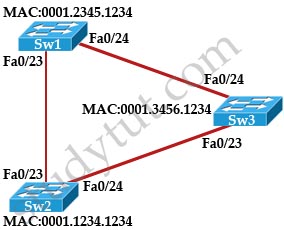
Your company has just added three new switches and they are connected as the topology below. After the STP convergence, which ports will become designated ports, suppose all switches are using default priority?
A. Sw1 – Fa0/23
B. Sw1 – Fa0/24
C. Sw2 – Fa0/23
D. Sw2 – Fa0/24
E. Sw3 – Fa0/23
F. Sw3 – Fa0/24
Answer: B C D
Explanation
First by comparing their MAC addresses we learn that Sw1 will be root bridge as it has lowest MAC. Therefore all of its ports are designated ports -> C & D are correct.
On the link between Sw1 & Sw3 there must have one designated port and one non-designated (blocked) port. We can figure out which port is designated port by comparing their MAC address again. A has lower MAC so Fa0/24 of Sw1 will be designated port while Fa0/24 of Sw3 will be blocked -> B is correct.
Question 2
What parameter is mostly used to specify the root port on non-root bridges?
A. MAC address
B. Revision number
C. Port priority number
D. Path cost
Answer: D
Explanation
The path cost to the root bridge is the most important value to determine which port will become the root port on each non-root switch. In particular, the port with lowest cost to the root bridge will become root port (on non-root switch).
Question 3
Which statements are correct about PVST+?
A. PVST+ helps saving some VLAN instances
B. PVST+ maintains a spanning tree instance for each VLAN
C. PVST+ allows choosing the root bridge location to optimize the traffic of each VLAN
D. PVST+ reduces Layer 3 loops
Answer: B C
Explanation
Per VLAN Spanning Tree (PVST) maintains a spanning tree instance for each VLAN configured in the network. It means a switch can be the root bridge of a VLAN while another switch can be the root bridge of other VLANs in a common topology. For example, Switch 1 can be the root bridge for Voice data while Switch 2 can be the root bridge for Video data. If designed correctly, it can optimize the network traffic.
Question 4
What Layer 2 protocols are used to prevent loops? (Choose two)
A. 802.1Q
B. STP
C. 802.1d
D. 802.3
E. VTP
Answer: B C
Question 5
After investigating your company network, you realize that multiple copies of unicast packets are transmitted in your LAN. What is the most likely problem?
A. There is a broken link somewhere in your LAN
B. During in high traffic time
C. You are having an improperly redundant topology
D. Your network is using star topology
E. Your network is using token ring topology
Answer: C
Explanation
If we connect two switches via 2 or more links and do not enable STP on these switches then a loop (which creates multiple copies of the same unicast frame) will occur. It is an example of an improperly implemented redundant topology.
Question 6
Refer to the topology below:
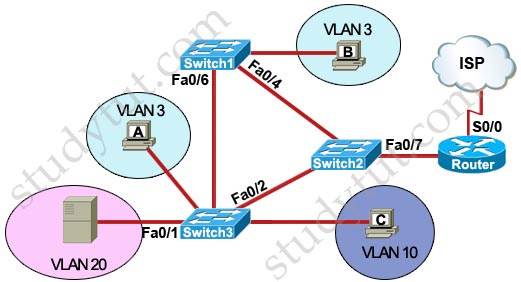
What will be the result of Fa0/6 on Switch1 being disconnected if all switches are using default values?
A. Host B cannot get data from the Server in VLAN 20
B. Host B cannot communicate to other hosts in other VLANs
C. Host B can still communicate to other hosts in other VLANs but the communication is very slow
D. Host B cannot access the server in VLAN 20 in less than one minute. Then the normal connection would resume
Answer: D
Question 7
What is the new port state of Rapid-PVST?
A. blocking
B. learning
C. listening
D. forwarding
E. discarding
Answer: E
Explanation
PVST+ is based on IEEE802.1D Spanning Tree Protocol (STP). But PVST+ has only 3 port states (discarding, learning and forwarding) while STP has 5 port states (blocking, listening, learning, forwarding and disabled). So discarding is a new port state in PVST+.
Question 8
Given the topology below. All parameters are set to default, which switch will become the root bridge?
A. Sw1, because of its lowest MAC
B. Sw1, because of its lowest priority
C. Sw2, because of its lowest MAC
D. Sw2, because of its lowest priority
E. Sw3, because of its lowest MAC
F. Sw3, because of its lowest priority
G. Sw4, because of its lowest priority
Answer: F
Question 9
Your Layer 2 network has all switch ports in either blocking or forwarding states. Which term is often used to describe this state?
A. complete
B. successful
C. converged
D. good
E. full
Answer: C
Explanation
Spanning Tree Protocol convergence (Layer 2 convergence) happens when bridges and switches have transitioned to either the forwarding or blocking state. When layer 2 is converged, root bridge is elected and all port roles (Root, Designated and Non-Designated) in all switches are selected.
Question 10
Switch# show spanning-tree interface fastethernet0/5
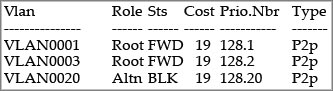
From the output below, what is the most likely cause that interface fa0/5 is not the root port on VLAN 20?
A. Another port has lower path cost to the root bridge
B. The priority of this port is higher than another port in VLAN 20
C. This switch can only become root bridge for odd VLAN numbers
D. Interface Fa0/5 is manually set to Alternative state
Answer: A