Free Cisco Questions Category

Security Questions

January 4th, 2016

Question 1

Which Cisco Catalyst feature automatically disables the port in an operational PortFast upon receipt of a BPDU?

Which feature will disable an operating interface automatically when receiving a BPDU?

A. BackboneFast
B. UplinkFast
C. Root Guard
D. BPDU Guard
E. BPDU Filter


Answer: D

Explanation

We only enable PortFast feature on access ports (ports connected to end stations). But if someone does not know he can accidentally plug that port to another switch and a loop may occur when BPDUs are being transmitted and received on these ports.

With BPDU Guard, when a PortFast receives a BPDU, it will be shut down to prevent a loop -> D is correct.

Question 2

Which two commands correctly verify whether port security has been configured on port FastEthernet 0/5 on a switch? (Choose two)

A. Switch# show switchport port-security interface FastEthernet 0/5
B. Switch# show port-secure interface FastEthernet 0/5
C. Switch# show port-security interface FastEthernet 0/5
D. Switch# show running-config


Answer: C D

Explanation

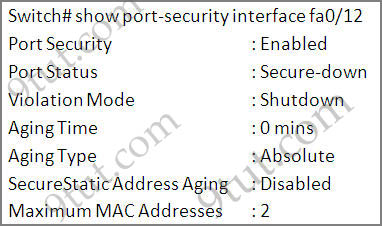
We can verify whether port security has been configured by using the “show running-config” or “show port-security interface ” for more detail. An example of the output of “show port-security interface ” command is shown below:

show_port-security_interface.jpg

Syslog Questions

January 4th, 2016

Question 1

Where are Syslog messages stored in a router? (Choose three)

A. Flash
B. Syslog Servers
C. TFTP
D. Logging buffer on RAM
E. Console terminal

Answer: B D E

Explanation

By default, switches send the output from system messages and debug privileged EXEC commands to a logging process. The logging process controls the distribution of logging messages to various destinations, such as the logging buffer (on RAM), terminal lines (console terminal), or a UNIX syslog server, depending on your configuration. The process also sends messages to the console.

(Reference: http://www.cisco.com/en/US/docs/switches/lan/catalyst2950/software/release/12.1_9_ea1/configuration/guide/swlog.html#wp1024032)

Note: Syslog messages can be written to a file in Flash memory although it is not a popular place to use. We can configure this feature with the command logging file flash:filename.

Question 2

You have configured Syslog to store level 3 trap. Which type of logs would be created? (Choose four)

A. Emergencies
B. Alerts
C. Errors
D. Warnings
E. Notification
F. Critical

Answer: A B C F

Explanation

The Message Logging is divided into 8 levels as listed below:

Level Keyword Description
0 emergencies System is unusable
1 alerts Immediate action is needed
2 critical Critical conditions exist
3 errors Error conditions exist
4 warnings Warning conditions exist
5 notification Normal, but significant, conditions exist
6 informational Informational messages
7 debugging Debugging messages

The highest level is level 0 (emergencies). The lowest level is level 7. If you specify a level with the “logging console level” command, that level and all the higher levels will be displayed. For example, by using the “logging console warnings” command, all the logging of emergencies, alerts, critical, errors, warnings will be displayed.

In this question level 3 trap is configured so Emergencies, Alerts, critical and Errors messages are displayed.

Question 3

Which of the following command tell the router to include milliseconds in the time stamp of Syslog debug messages?

A. service log timestamps datetime local
B. service timestamps debug datetime msec
C. service timestamps debug datetime localtime
D. service log timestamps datetime msec


Answer: B

Explanation

The “service timestamps debug” command configures the system to apply a time stamp to debugging messages. The time-stamp format for datetime is MMM DD HH:MM:SS, where MMM is the month, DD is the date, HH is the hour (in 24-hour notation), MM is the minute, and SS is the second. With the additional keyword msec, the system includes milliseconds in the time stamp, in the format HH:DD:MM:SS.mmm, where .mmm is milliseconds

(Reference: http://www.cisco.com/c/en/us/td/docs/ios/fundamentals/command/reference/cf_book/cf_r1.html#wp1030116)

Question 4

What is the default level of Syslog facility?

A. local4
B. local5
C. local6
D. local7
E. local3


Answer: D

Question 5

The network administrator issued the following command on a router:

TUT_ROUTER(config)# logging trap 4

Which Syslog messages will be sent to the administrator? (Choose four)

A. Emergency
B. Notice
C. Alert
D. Error
E. Warning


Answer: A C D E

Explanation

The Message Logging is divided into 8 levels as listed below:

Level Keyword Description
0 emergencies System is unusable
1 alerts Immediate action is needed
2 critical Critical conditions exist
3 errors Error conditions exist
4 warnings Warning conditions exist
5 notification Normal, but significant, conditions exist
6 informational Informational messages
7 debugging Debugging messages

If you specify a level with the “logging trap level” command, that level and all the higher levels will be logged. For example, by using the “logging trap 4” command, all the logging of emergencies, alerts, critical, errors, warnings will be logged.

Question 6

The network administrator issued the following command on a router:

TUT_ROUTER(config)# logging trap 3

Which Syslog messages will be sent to the administrator? (Choose three)

A. informational
B. emergency
C. warning
D. critical
E. debug
F. error


Answer: B D F

SNMP Questions

December 27th, 2015

Question 1

Which of the following items are SNMP components? (Choose three)

A. SNMP Manager
B. SNMP Netflow
C. SNMP Agent
D. SNMP Trap
E. MIB

Answer: A C E

Explanation

SNMP is an application-layer protocol that provides a message format for communication between SNMP managers and agents. SNMP provides a standardized framework and a common language used for the monitoring and management of devices in a network.
The SNMP framework has three parts:

+ An SNMP manager
+ An SNMP agent
+ A Management Information Base (MIB)

The SNMP manager is the system used to control and monitor the activities of network hosts using SNMP. The most common managing system is called a Network Management System (NMS). The term NMS can be applied to either a dedicated device used for network management, or the applications used on such a device. A variety of network management applications are available for use with SNMP. These features range from simple command-line applications to feature-rich graphical user interfaces (such as the CiscoWorks2000 line of products).

The SNMP agent is the software component within the managed device that maintains the data for the device and reports these data, as needed, to managing systems. The agent and MIB reside on the routing device (router, access server, or switch). To enable the SNMP agent on a Cisco routing device, you must define the relationship between the manager and the agent.

The Management Information Base (MIB) is a virtual information storage area for network management information, which consists of collections of managed objects.

(Reference: http://www.cisco.com/en/US/docs/ios/12_2/configfun/configuration/guide/fcf014.html#wp1017597)

Question 2

<Cannot replicate>
Question 3

What two types of alert messaged created by SNMP agents called?

A. TRAP
B. TRANSPORT
C. INFORM
D. INFORMATION

Answer: A C

Explanation

A TRAP is a SNMP message sent from one application to another (which is typically on a remote host). Their purpose is merely to notify the other application that something has happened, has been noticed, etc. The big problem with TRAPs is that they’re unacknowledged so you don’t actually know if the remote application received your oh-so-important message to it. SNMPv2 PDUs fixed this by introducing the notion of an INFORM, which is nothing more than an acknowledged TRAP.

Question 4

What are new features in SNMPv3 compared to SNMPv2? (Choose three)

A. Message integrity
B. Load Buffer
C. Error Control
D. Encryption
E. Authentication


Answer: A D E

Explanation

Cisco IOS software supports the following versions of SNMP:

+ SNMPv1 – The Simple Network Management Protocol: A Full Internet Standard, defined in RFC 1157. (RFC 1157 replaces the earlier versions that were published as RFC 1067 and RFC 1098.) Security is based on community strings.

+ SNMPv2c – The community-string based Administrative Framework for SNMPv2. SNMPv2c (the “c” stands for “community”) is an Experimental Internet Protocol defined in RFC 1901, RFC 1905, and RFC 1906. SNMPv2c is an update of the protocol operations and data types of SNMPv2p (SNMPv2 Classic), and uses the community-based security model of SNMPv1.

+ SNMPv3 – Version 3 of SNMP. SNMPv3 is an interoperable standards-based protocol defined in RFCs 2273 to 2275. SNMPv3 provides secure access to devices by a combination of authenticating and encrypting packets over the network. The security features provided in SNMPv3 are as follows:

– Message integrity: Ensuring that a packet has not been tampered with in transit.
– Authentication: Determining that the message is from a valid source.
– Encryption: Scrambling the contents of a packet prevent it from being learned by an unauthorized source.

(Reference: http://www.cisco.com/en/US/docs/ios/12_2/configfun/configuration/guide/fcf014.html#wp1010901)

Question 5

Which of the following protocol is used in SNMPv3 authentication?
A.
<Ignore>
Question 6

Which of the following statements are correct about SNMP? (Choose three)?

A. SNMPv3 is more secured than SNMPv2
B. Inform message is added in SNMPv3
C. GetBulk message is added in SNMPv3
D. GetBulk message is added in SNMPv2
E. Inform message is added in SNMPv2


Answer: A D E

Explanation

SNMPv1/v2 can neither authenticate the source of a management message nor provide encryption. Without authentication, it is possible for nonauthorized users to exercise SNMP network management functions. It is also possible for nonauthorized users to eavesdrop on management information as it passes from managed systems to the management system. Because of these deficiencies, many SNMPv1/v2 implementations are limited to simply a read-only capability, reducing their utility to that of a network monitor; no network control applications can be supported. To correct the security deficiencies of SNMPv1/v2, SNMPv3 was issued as a set of Proposed Standards in January 1998. -> A is correct.

(Reference: http://www.cisco.com/web/about/ac123/ac147/archived_issues/ipj_1-3/snmpv3.html)

The two additional messages are added in SNMP2 (compared to SNMPv1)

GetBulk Request: The GetBulk Request message enables an SNMP manager to access large chunks of data. GetBulk Request allows an agent to respond with as much information as will fit in the response PDU. Agents that cannot provide values for all variables in a list will send partial information. -> E is correct.

Inform Request: The Inform Request message allows NMS stations to share trap information. (Traps are issued by SNMP agents when a device change occurs.) Inform Request messages are generally used between NMS stations, not between NMS stations and agents. -> C is correct.

Note: These two messages are carried over SNMPv3.

Question 7

How can security be implemented on SNMPv2?

A. AES
B. community string
C. HMAC
D. 3DES
E. MD5

Answer: B

NetFlow Questions

December 27th, 2015

Question 1

What can NetFlow provide for your network? (Choose three)

A. Network, User and Application Monitoring
B. Security Analysis
C. Accounting/Billing
D. Network Resources


Answer: A B C

Explanation

NetFlow traditionally enables several key customer applications including:

+ Network Monitoring – NetFlow data enables extensive near real time network monitoring capabilities. Flow-based analysis techniques may be utilized to visualize traffic patterns associated with individual routers and switches as well as on a network-wide basis (providing aggregate traffic or application based views) to provide proactive problem detection, efficient troubleshooting, and rapid problem resolution.

+ Application Monitoring and Profiling – NetFlow data enables network managers to gain a detailed, time-based, view of application usage over the network. This information is used to plan, understand new services, and allocate network and application resources (e.g. Web server sizing and VoIP deployment) to responsively meet customer demands.

+ User Monitoring and Profiling – NetFlow data enables network engineers to gain detailed understanding of customer/user utilization of network and application resources. This information may then be utilized to efficiently plan and allocate access, backbone and application resources as well as to detect and resolve potential security and policy violations.

+ Network Planning – NetFlow can be used to capture data over a long period of time producing the opportunity to track and anticipate network growth and plan upgrades to increase the number of routing devices, ports, or higher- bandwidth interfaces. NetFlow services data optimizes network planning including peering, backbone upgrade planning, and routing policy planning. NetFlow helps to minimize the total cost of network operations while maximizing network performance, capacity, and reliability. NetFlow detects unwanted WAN traffic, validates bandwidth and Quality of Service (QOS) and allows the analysis of new network applications. NetFlow will give you valuable information to reduce the cost of operating your network.

+ Security Analysis – NetFlow identifies and classifies DDOS attacks, viruses and worms in real-time. Changes in network behavior indicate anomalies that are clearly demonstrated in NetFlow data. The data is also a valuable forensic tool to understand and replay the history of security incidents.

+ Accounting/Billing – NetFlow data provides fine-grained metering (e.g. flow data includes details such as IP addresses, packet and byte counts, timestamps, type-of-service and application ports, etc.) for highly flexible and detailed resource utilization accounting. Service providers may utilize the information for billing based on time-of-day, bandwidth usage, application usage, quality of service, etc. Enterprise customers may utilize the information for departmental charge-back or cost allocation for resource utilization.

(Reference: http://www.cisco.com/en/US/products/sw/netmgtsw/ps1964/products_implementation_design_guide09186a00800d6a11.html#wp1030045)

Question 2

What set of attributes must be identical in the same flow? (Choose three)

A. IP address
B. Port number
C. Interface description
D. Layer 3 protocol type
E. MAC address


Answer: A B D

Explanation

What is an IP Flow?
Each packet that is forwarded within a router or switch is examined for a set of IP packet attributes. These attributes are the IP packet identity or fingerprint of the packet and determine if the packet is unique or similar to other packets.
Traditionally, an IP Flow is based on a set of 5 and up to 7 IP packet attributes.
IP Packet attributes used by NetFlow:
+ IP source address
+ IP destination address
+ Source port
+ Destination port
+ Layer 3 protocol type
+ Class of Service
+ Router or switch interface

(Reference: http://www.cisco.com/c/en/us/products/collateral/ios-nx-os-software/ios-netflow/prod_white_paper0900aecd80406232.html)

Question

Which of the following component is used to track IPv4 traffic when applied to an interface?

A. flow monitor
B. flow record
C. flow sampler
D. flow exporter


Answer: A

Explanation

Flow monitors are the Flexible NetFlow component that is applied to interfaces to perform network traffic monitoring. Flow monitors consist of a record and a cache. You add the record to the flow monitor after you create the flow monitor. The flow monitor cache is automatically created at the time the flow monitor is applied to the first interface. Flow data is collected from the network traffic during the monitoring process based on the key and nonkey fields in the record, which is configured for the flow monitor and stored in the flow monitor cache.
For example, the following example creates a flow monitor named FLOW-MONITOR-1 and enters Flexible NetFlow flow monitor configuration mode:
Router(config)# flow monitor FLOW-MONITOR-1
Router(config-flow-monitor)#

(Reference: http://www.cisco.com/c/en/us/td/docs/ios/fnetflow/command/reference/fnf_book/fnf_01.html#wp1314030)

Question

Which of the following command can be issued to visualize the NetFlow data?

A. show ip netflow
B. show ip flow
C. show ip cache flow
D. show ip netflow sampling
E. show netflow


Answer: C

Explanation

The “show ip cache flow” command displays a summary of the NetFlow accounting statistics.
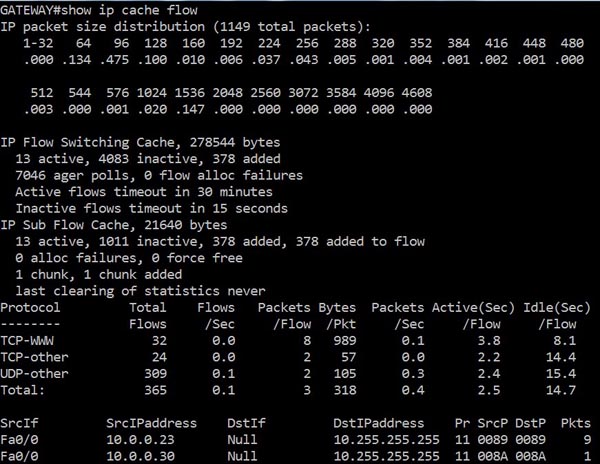
show_ip_cache_flow.jpg

Question

Your company wants to implement NetFlow. What are the benefits of NetFlow to analyze your company data? (Choose three)

A. Identify applications causing congestion.
B. Validate the user rights
C. Inform about status of the link
D. Diagnose slow network performance, bandwidth hogs and bandwidth utilization
E. Detect suboptimal routing in the network.
F. Confirm that appropriate bandwidth has been allocated to each Class of Service


Answer: A D F

Explanation

NetFlow facilitates solutions to many common problems encountered by IT professionals.
+ Analyze new applications and their network impact
Identify new application network loads such as VoIP or remote site additions.
+ Reduction in peak WAN traffic
Use NetFlow statistics to measure WAN traffic improvement from application-policy changes; understand who is utilizing the network and the network top talkers.
+ Troubleshooting and understanding network pain points
Diagnose slow network performance, bandwidth hogs and bandwidth utilization quickly with command line interface or reporting tools. -> D is correct.
+ Detection of unauthorized WAN traffic
Avoid costly upgrades by identifying the applications causing congestion. -> A is correct.
+ Security and anomaly detection
NetFlow can be used for anomaly detection and worm diagnosis along with applications such as Cisco CS-Mars.
+ Validation of QoS parameters
Confirm that appropriate bandwidth has been allocated to each Class of Service (CoS) and that no CoS is over- or under-subscribed.-> F is correct.

(Reference: http://www.cisco.com/c/en/us/products/collateral/ios-nx-os-software/ios-netflow/prod_white_paper0900aecd80406232.html)

Question

Your network is running slowly recently. Which feature can you use to find out which application is causing this problem?

A. IP SLA
B. NetFlow
C. SNMP
D. SMTP
E. TFTP


Answer: B

Question

Your colleague is going to implement NetFlow on his network. He asks you which factors should be considered before running NetFlow. What will you tell him? (Choose three)

A. CPU ultilization
B. where NetFlow data is sent to
C. number of devices that are exporting NetFlow data
D. number of ports available
E. number of trunk links


Answer: A B C
HSRP VRRP GLBP

December 27th, 2015

Question 1

Which of the following MAC is a HSRP Virtual MAC address?

A. 0000.0c07.AB03
B. 0000.0c07.AD01
C. 0000.0c07.AC05
D. 0000.0c07.0001


Answer: C

Explanation

With HSRP, two or more devices support a virtual router with a fictitious MAC address and unique IP address. There are two version of HSRP.

+ With HSRP version 1, the virtual router’s MAC address is 0000.0c07.ACxx , in which xx is the HSRP group.
+ With HSRP version 2, the virtual MAC address if 0000.0C9F.Fxxx, in which xxx is the HSRP group.

Note: Another case is HSRP for IPv6, in which the MAC address range from 0005.73A0.0000 through 0005.73A0.0FFF.

-> C is correct.

(Good resource for HSRP: http://www.cisco.com/en/US/docs/switches/datacenter/sw/5_x/nx-os/unicast/configuration/guide/l3_hsrp.html)

Question 2

Which of the following statements are correct about the HSRP operation? (Choose three)

A. The HSRP master router uses the virtual IP and MAC addresses to receive traffic
B. The default hello and dead interval are 3 seconds and 10 seconds, respectively
C. HSRP gets the IP address of the active router to use as the HSRP virtual IP address
D. HSRP supports up to 255 groups per interface and we can achieve a form of load balancing via multiple groups
E. HSRP does not support md5 authentication
F. The virtual IP address of HSRP must be in a different subnet than the IP addresses of the interfaces joining that HSRP group


Answer: A B D

Explanation

For more information about HSRP operation, please read our HSRP tutorial.

Question 3

What is the main function of VRRP object tracking?

A. It analyzes traffic flow and link ultilization
B. It makes sure the best VRRP router is the virtual router master
C. Traffic will flow to the higher bandwidth links automatically
D. It enhances security for the routers


Answer: B

Explanation

Object tracking is the process of tracking the state of a configured object and uses that state to determine the priority of the VRRP router in a VRRP group -> B is correct.

(Reference: http://www.cisco.com/c/en/us/td/docs/switches/datacenter/sw/5_x/nx-os/unicast/configuration/guide/l3_cli_nxos/l3_vrrp.html#wp1074871)

Note: Unlike HSRP which can track interface status directly, VRRP can only track interface status through a tracked object.

Question 4

Which router in GLBP will responsible for responding to client ARP request?

A. Active Virtual Gateway (AVG)
B. The router with highest IP address
C. All the routers participate in GLBP group
D. Any router in the GLBP group


Answer: A

Explanation

One disadvantage of HSRP and VRRP is that only one router is in use, other routers must wait for the primary to fail because they can be used. However, Gateway Load Balancing Protocol (GLBP) can use of up to four routers simultaneously. In GLBP, there is still only one virtual IP address but each router has a different virtual MAC address. First a GLBP group must elect an Active Virtual Gateway (AVG). The AVG is responsible for replying ARP requests from hosts/clients. It replies with different virtual MAC addresses that correspond to different routers (known as Active Virtual Forwarders – AVFs) so that clients can send traffic to different routers in that GLBP group (load sharing).

Question 5
<Same as 4>

Question 6

Which of the following statements are correct about GLBP? (Choose three)

A. GLBP supports authentication with plain text and MD5 methods
B. In a GLBP group, there is one active AVG and one standby AVG
C. GLBP does not support plain text authentication
D. GLBP supports up to 1024 virtual routers per physical interface of a router
E. GLBP does not support interface tracking
F. GLBP can load balance traffic up to four routers


Answer: A D F

DHCP Questions

December 27th, 2015

Question 1
What IP addresses should not be assigned to hosts and should be removed from DHCP pool? (Choose two)
A. The IP address which has the last octet is 1
B. The IP address which has the last octet is 255
C. The network address of the subnetwork
D. The broadcast address of the network or subnetwork

Answer: C D
Question 2
What are the functions of DHCP? (Choose two)
A. DHCP uses a pool to assign and renew IP addresses
B. Detect when a new host is connected to the network and assign a suitable IP address for it
C. Working as a gateway so that hosts can communicate to the outside
D. Assign parameters of IP address from a DHCP Server to a host
E. Responsible for assigning MAC and IP address when requested

Answer: A D
Question 3
What will a DHCP server do when an IP conflict is detected?
A. The DHCP Server sends DHCPCONFLICT messages to both hosts
B. The DHCP Server sends DHCPCONFLICT messages to all hosts in the network
C. The conflicted IP is removed from the pool until the conflict is solved
D. The conflicted IP is kept in the pool but is not allocated to any hosts
E. DHCP Server informs to all conflicted host to remove that IP address

Answer: C
Question 4
Which of the following statements is correct about DHCP after assigning an IP address to a host?
A. DHCP Server assigns addresses to hosts permanently and that host always has the same address all the time
B. DHCP Server assigns addresses to hosts for a fixed period of time. When the time expires, host must send a request for another IP address
C. Addresses are assigned to host and the host can keep the same address by contacting the DHCP Server periodically to renew the lease
D. The DHCP Server and the hosts will negotiate to specific the length of the lease

Answer: C

Question 5
Which of the following statement decribes how DHCP works?
A. If there is an address conflict, the conflict IP address will be taken out of the pool until an administrator resolve the conflict
B. DHCP conflicts are detected by using gratuitous ARP
C. Before accepting the IP offer from a DHCP server, DHCP client tries to detect an IP conflict by pinging that IP address. If no reply received, it accepts the offered IP
D. DHCP client sends a DHCP Request message to find out the DHCP server

Answer: A

WAN Questions

December 27th, 2015

Question 1

Your company has just expanded to a new location in another city. Which WAN technology should you use to save your money while ensure a always-up connectivity?

A. Packet switched
B. Circuit switched
C. Leased line
D. Wireless


Answer: A

Explanation

Circuit-switched connections are a poor choice because they are not usually always on, and they get expensive the longer they are connected. Leased lines have  always-on connectivity, but at a prohibitive cost.

Wireless does not  have the range to cover interstate distances.

Question 2

You connect the serial interface of a Cisco router running default encapsulation to a serial interface of a Juniper router which is running HDLC encapsulation. You notice that the two routers cannot send and receive data. What is the problem?

A. Cisco router does not support HDLC encapsulation so you have change the encapsulation of the Juniper router.
B. Cisco router is running IETF encapsulation so you must change it to HDLC encapsulation. Cisco router is running proprietary HDLC implementation so it does not compatible with other vendor’s HDLC implementations
D. This Cisco router is running an old version so you need to upgrade it so that two routers can communicate


Answer: C

Switch Questions

December 25th, 2015

Question

What will a switch do if it receives a frame with unknown destination MAC address?

A. It will flood the frame to all ports except the port where the frame came from
B. It will discard that frame
C. It will store that frame until it identifies the receiving device
D. It will send ARP Request on all ports to get more information about the destination MAC address


Answer: A

Trunking Questions

November 29th, 2015

Question

Which two commands must be configured under an interface of a Cisco switch which supports both ISL and 802.1Q to carry all VLANs to a Cisco 2960 switch? (Choose two)

A. Switch(config-if)#switchport mode access
B. Switch(config-if)#switchport mode both
C. Switch(config-if)#switchport mode trunk
D. Switch(config-if)#switchport trunk encapsulation dot1q


Answer: C D

Explanation

ISL and 802.1Q are two types of encapsulation that are used to carry data from multiple VLANs over trunk links. The Cisco 2950, 2960 switches do not support ISL encapsulation so we only need to use the single command “switchport mode trunk” to configure trunking. But Cisco 3550, 3560 switches do support both ISL and 802.1Q trunking so we have to use two commands “switchport trunk encapsulation dot1q” (to choose 802.1Q encapsulation protocol) and “switchport mode trunk” (to set trunking).

For your information, the Cisco Catalyst 4500/4000 series switches do not support ISL while the Cisco Catalyst 6500/6000 series support both ISL and 802.1Q.

Question

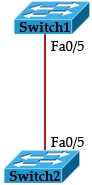
Two switches are connecting via their Fa0/5 interfaces using crossover cable. Switch1 is receiving this error:

%SPANTREE-7-RECV_1Q_NON_TRUNK: Received 802.1Q BPDU on non trunk FastEthernet0/5 VLAN1.
%SPANTREE-7-BLOCK_PORT_TYPE: Blocking FastEthernet0/5 on VLAN0001. Inconsistent port type.

two_switches.jpg

What is the reason of this error?

A. One of the two ports is shut down
B. Fa0/5 on Switch1 is configured as an access port while Fa0/5 on Switch2 is configured as a trunk port.
C. The trunking modes on two switches are mismatched
D. Switch1 is running Spanning Tree Protocol while Swich2 is not.
E. There is an access-list on Switch1 that drops all BPDU packets


Answer: B

Explanation

Switch1 received the error “Received 802.1Q BPDU on non trunk FastEthernet0/5 VLAN1” that means Fa0/5 on Switch1 is not a trunk port -> it is configured as an access port.

Question

Which of the following protocol should be configured between two switches in order to send traffic from multiple VLANs?

two_switches.jpg

A. Spanning Tree Protocol
B. VLAN Trunking Protocol
C. IEEE 802.1Q
D. DHCP
E. ARP


Answer: C

Explanation

802.1Q (and ISL) are two types of encapsulation that are used to carry data from multiple VLANs over trunk links.

Question

An networking engineer issued the following commands on a Cisco switch but an error occurred.

Switch(config)# interface fastethernet 0/1
Switch(config-if)# switchport mode trunk
Command rejected: An interface whose trunk encapsulation is “Auto” can not be configured to “trunk” mode.

What was the reason of this problem?

A. Trunking is not supported on this switch
B. We must set the mode to “auto” first
C. The encapsulation type must be set to 802.1q first
D. The command “no switch mode auto” must be issued first


Answer: C

Explanation

The error occurs when the switch supports both IEEE 802.1Q and ISL encapsulations. In this switch you must choose which trunking encapsulation should be used first before setting it into “trunk” (with “switchport mode trunk” command). To choose trunking encapsulation method, use the “switchport trunk encapsulation {isl | dot1q}” command).

Question

Refer to the exhibit.

two_switches.jpg

What will be the result of the configuration shown below.

Switch1(config)#interface fa0/5
Switch1(config-if)#switchport trunk encapsulation dot1q
Switch1(config-if)#switch mode trunk
Switch1(config-if)#switchport trunk native vlan 5
Switch2(config)#interface fa0/5
Switch2(config-if)#switchport trunk encapsulation isl
Switch2(config-if)#switch mode trunk
Switch2(config-if)#switchport trunk native vlan 5

A. The link between two switches can operate normally
B. The link between two switches can still operate but only traffic for VLAN 5 can pass through
C. The link between two switches can still operate except traffic for VLAN 5
D. The link is down and no traffic can pass through


Answer: D

Explanation

The trunking encapsulation on two interfaces are not matched (one is set to “dot1q” while the other is set to “isl”) so the link is down and no traffic can pass through.

Question

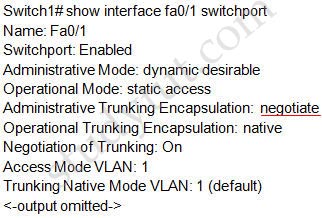
Check the output below. What can be said about setting the “Administrative Trunking Encapsulation” to “negotiate”?

show_int_switchport.jpg

A. This switch only supports IEEE 802.1Q trunking
B. This switch supports both IEEE 802.1Q and ISL trunking
C. This port can operate in trunking mode or access mode
D. This switch only supports ISL trunking


Answer: B

Explanation

The Administrative Trunking Encapsulation is set to “negotiate” means this switch supports both IEEE 802.1Q and ISL. If the switch only supports 802.1Q or it is set to 802.1Q, it will show “Administrative Trunking Encapsulation: dot1q”.

IPv6 Questions

November 29th, 2015

Question

Which of the following options is a valid IPv6 address?

A. 1731:0:909F::9D0:876B:130D
B. 2111:0D08:0000:121F:0000:0000:09GC:150B
C. 2011:0CA8:0:130H::87D:141C
D. 2031::130F::9D0:176A:386B


Answer: A

Explanation

Answer B is not correct because it has a letter “G”.
Answer C is not correct because it has a letter “H”.
Answer D is not correct because it has two “::”.

Question

What is the advantage of IPv6 packet processing over IPv4 packet processing?

A. variable header size
B. fixed header size
C. less header size
D. header size is always 34 bits


Answer: B

Explanation

The IPv6 header is always present and is a fixed size of 40 bytes which reduces router processing.

Question

Which of the following statements are correct about IPv6? (Choose two)

A. Multicasts have been eliminated and replaced with broadcasts
B. Broadcasts have been eliminated and replaced with multicasts
C. Each router interface can only be assigned with one IPv6 address
D. IPv6 addresses do not have subnet mask part
E. An IPv6 address consists of 128 bits


Answer: B E

Question 9

Which command is used to enable IPv6 forwarding on a Cisco router?

A. IPv6 routing-update
B. IPv6 unicast-routing
C. IPv6 enable
D. IPv6 start


Answer: B

Explanation

An example of configuring RIPng (similar to RIPv2 but is used for IPv6) is shown below:

Router(config)#ipv6 unicast-routing (Enables the forwarding of IPv6 unicast datagrams globally on the router)
Router(config)#interface fa0/0
Router(config-if)#ipv6 rip 9tut enable (9tut is the process name of this RIPng)