RSTP Questions
Question 1
What facts about RSTP are true? (Choose three)
A. The topology recovers significantly faster when a link fails
B. There are two additional port soles comparing to STP, which are backup and alternative roles
C. There are four port roles in RSTP which blocking, discarding, learning and forwarding
D. The recovery time of RSTP is nearly the same as STP
E. RSTP transitions to forwarding state faster than STP on point to point links
Answer: A B E
Question 2
Check the output below:
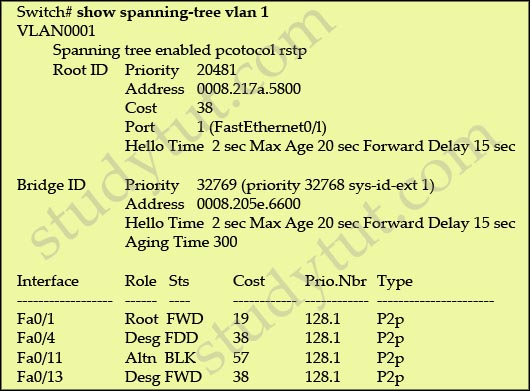
What conclusion can be made from this output?
A. There are more than one port that connect to the root bridge
B. The root bridge is running normal spanning-tree protocol
C. The MAC address of the root bridge is lower than that of the local switch
D. The bridge ID of the root bridge is higher than that of the local switch
Answer: D
Explanation
As we can see from the output above, the priority of the root bridge is 20481 while that of the local bridge is 32769.
Question 3
What is the suitable command to enable RSTP?
A. Switch(config)#spanning-tree mode rapid-pvst
B. Switch(config)#spanning-tree mode pvst
C. Switch(config)#spanning-tree mode rstp
D. Switch(config)#spanning-tree guard loop
E. Switch(config)#spanning-tree mode rapid-stp
Answer: A
Question 4
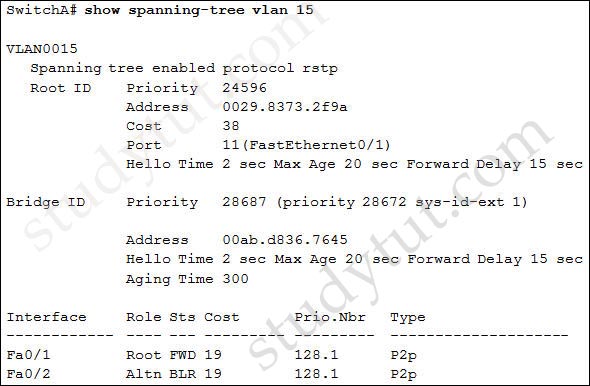
Check the output below. Which of the following statements is correct?
<Redraw;Fa0/11,12 -> Fa0/1,2;SwitchA -> Switch;VLAN20->VLAN15;change root MAC>
A. From the role of Fa0/1 we can conclude this is the root bridge
B. VLAN 15 is running pvst
C. The root bridge MAC address is 00ab.d836.7645
D. From the port roles we can conclude this is not the root bridge
Answer: D
Explanation
Only non-root bridge can have root port. Fa0/1 is the root port so we can confirm this switch is not the root bridge -> A is not correct.
From the output we learn this switch is running Rapid STP, not PVST -> B is not correct.
00ab.d836.7645 is the MAC address of this switch, not of the root bridge. The MAC address of the root bridge is 0029.8373.2f9a -> C is not correct.
All of the interface roles of the root bridge are designated. SwitchA has one Root port and 1 Alternative port so it is not the root bridge -> D is correct.
Question 5
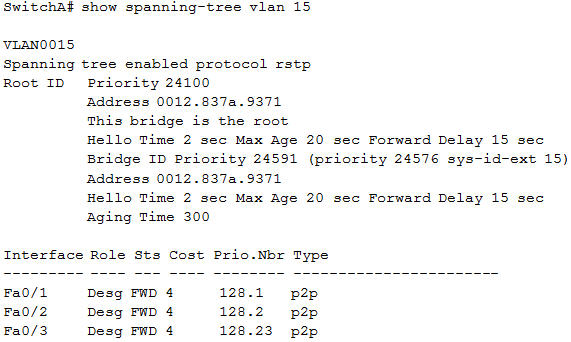
Check the output below. Which of the following statements are correct? (Choose three)
A. All ports are in the state of discarding, forwarding or learning
B. There are 300 VLANs on this switch
C. The root priority of this switch is lower than the default priority
D. All three interfaces on this switch are in shared media
E. Ports in designated role are forwarding traffic
F. Besides VLAN 15, this switch is also the root bridge for other VLANs
Answer: A C E
Explanation
From the output, we see that all ports are in Designated role (forwarding state) -> A and E are correct.
The command “show spanning-tree vlan 15″ only shows us information about VLAN 15. We don’t know how many VLAN exists in this switch -> B is not correct.
The bridge priority of this switch is 24100 which is lower than the default value bridge priority 32768 -> C is correct.
All three interfaces on this switch have the connection type “p2p”, which means Point-to-point environment – not a shared media -> D is not correct.
The only thing we can specify is this switch is the root bridge for VLAN 15 but we can not guarantee it is also the root bridge for other VLANs -> F is not
Question 6
What are the port states of RSTP when it has converged? (Choose two)
A. learning
B. listening
C. disabled
D. forwarding
E. discarding
Answer: D E
Explanation
RSTP only has 3 port states that are discarding, learning and forwarding. When RSTP has converged there are only 2 port states left: discarding and forwarding.
Question 7
Which of the following statements are correct about RSTP? (Choose two)
A. RSTP is compatible with the old 802.1D protocol
B. RSTP is not compatible with PVST+
C. RSTP is a proprietary protocol
D. RSTP introduces new port roles
E. RSTP introduces no new port roles
Answer: A D
Question 8
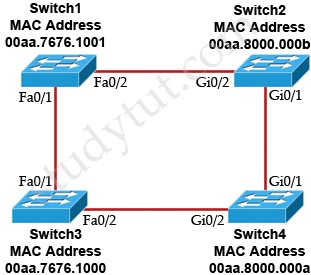
Refer to the topology below. All four switches in the topology are running RSTP with default settings. Which of the following statements describing port roles of the ports are correct?
A. Switch1,Fa0/2 with designated role
B. Switch1, Fa0/1 with root role
C. Switch2, Gi0/1 with root role
D. Switch2, Gi0/1 with designated role
E. Switch3, Fa0/2 with root role
F. Switch4, Gi0/2 with root role
Answer: A B F
Explanation
The question says “with default settings” so we can understand these switches have the same bridge priority. Switch3 has lowest MAC address so it will become root bridge and 2 of its ports (Fa0/1 & Fa0/2) will be designated ports -> E is incorrect.
Because Switch3 is the root bridge so the 2 ports nearest Switch3 on Switch1 (Fa0/1) and Switch4 (Gi0/2) will be root ports -> B and F are correct.
Now we come to the most difficult part of this question: Switch2 must have a root port so which port will it choose? To answer this question we need to know about STP cost and port cost.
In general, “cost” is calculated based on bandwidth of the link. The higher the bandwidth on a link, the lower the value of its cost. Below are the cost values you should memorize:
| Link speed | Cost |
| 10Mbps | 100 |
| 100Mbps | 19 |
| 1 Gbps | 4 |
Switch2 will choose the interface with lower cost to the root bridge as the root port so we must calculate the cost on interface Gi0/1 & Gi0/2 of Switch2 to the root bridge. This can be calculated from the “cost to the root bridge” of each switch because a switch always advertises its cost to the root bridge in its BPDU. The receiving switch will add its local port cost value to the cost in the BPDU.
In the exhibit you also we FastEthernet port is connecting to GigabitEthernet port. In this case GigabitEthernet port will operate as a FastEthernet port so the link can be considered as FastEthernet to FastEthernet connection.
One more thing to notice is that a root bridge always advertises the cost to the root bridge (itself) with an initial value of 0.
Now let’s have a look at the topology again
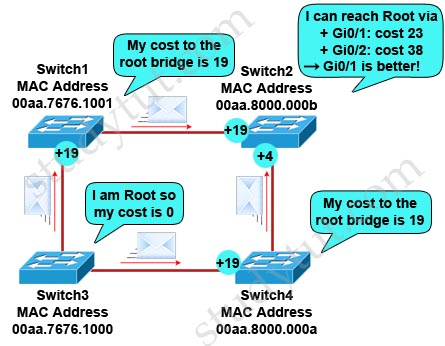
Switch3 advertises its cost to the root bridge with a value of 0. Switch4 adds 19 (the cost value of 100Mbps link although the port on Switch D is GigabitEthernet port) and advertises this value (19) to Switch2. Switch2 adds 4 (the cost value of 1Gbps link) and learns that it can reach Switch3 via Gi0/1 port with a total cost of 23. The same process happens for Switch1 and Switch2 learns that it can reach Switch3 via Gi0/2 with a total cost of 38 -> Switch2 chooses Gi0/1 as its root port -> D is not correct.
Now our last task is to identify the port roles of the ports between Switch1 & Switch2. It is rather easy as the MAC address of Switch1 is lower than that of Switch2 so Fa0/2 of Switch1 will be designated port while Gi0/2 of Switch2 will be alternative port -> A is correct but C is not correct.
Below summaries all the port roles of these switches:
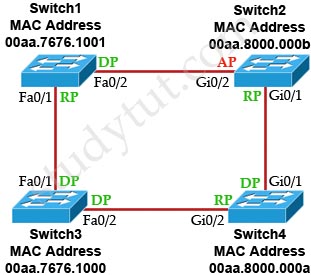
+ DP: Designated Port (forwarding state)
+ RP: Root Port (forwarding state)
+ AP: Alternative Port (blocking state)
Question 9
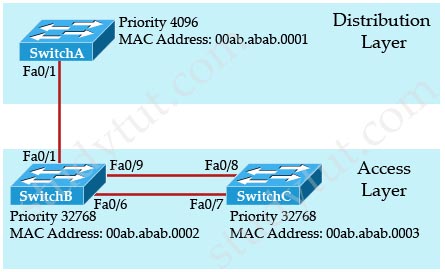
Refer to the topology below. After RSTP has been converged, which switch port on which switch in the Access layer will take the discarding role?
A. SwitchB, Fa0/6
B. SwitchB, Fa0/9
C. SwitchC, Fa0/7
D. SwitchC, Fa0/8
Answer: D
Explanation
In this question, we only care about the Access Layer switches (SwitchB & C). SwitchB has a lower bridge ID than SwitchC (because the MAC of SwitchB is smaller than that of SwitchC) so both ports of SwitchB will be in forwarding state. The alternative port will surely belong to SwitchC.
SwitchC will need to block one of its ports to avoid a bridging loop between the two switches. But how does SwitchC select its blocked port? Well, the answer is based on the BPDUs it receives from SwitchB. A BPDU is superior than another if it has:
1. A lower Root Bridge ID
2. A lower path cost to the Root
3. A lower Sending Bridge ID
4. A lower Sending Port ID
These four parameters are examined in order. In this specific case, all the BPDUs sent by SwitchC have the same Root Bridge ID, the same path cost to the Root and the same Sending Bridge ID. The only parameter left to select the best one is the Sending Port ID (Port ID = port priority + port index). In this case the port priorities are equal because they use the default value, so SwitchC will compare port index values, which are unique to each port on the switch, and because Fa0/9 is inferior to Fa0/6, SwitchC will select the port connected with Fa0/6 (of SwitchB) as its root port and block the other port -> Port fa0/8 of SwitchC will be blocked (discarding role).
If you are still not sure about this question, please read my RSTP tutorial.