OSPF Questions 2
Question 1
R1 and R2 are on the same segment but cannot establish OSPF neighbor relationship. What is the most likely problem?
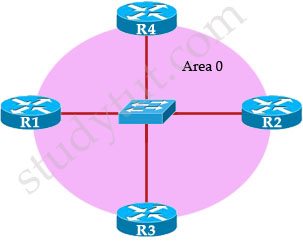
A. Two routers are using different process identifier
B. The hello and dead timers are mismatched on two routers
C. Two routers are configured in different areas
D. The costs on connected interfaces are mismatched
Answer: B C
Explanation
A is not correct because configure EIGRP on these routers (with a lower administrative distance) will force these routers to run EIGRP, not OSPF.
B is not correct because the backbone area of OSPF is always Area 0.
C and D are correct because these entries must match on neighboring routers:
– Hello and dead intervals
– Area ID (Area 0 in this case)
– Authentication password
– Stub area flag
Question 2
What parameter OSPF uses to calculate cost in Cisco devices?
A. MTU
B. Load
C. Bandwidth
D. Load and MTU
E. Delay and MTU
F. Bandwitdh and Delay
Answer: C
Explanation
The well-known formula to calculate OSPF cost is
Cost = 108 / Bandwidth
so C is the correct answer.
Question 3
<Redraw – Add picture>
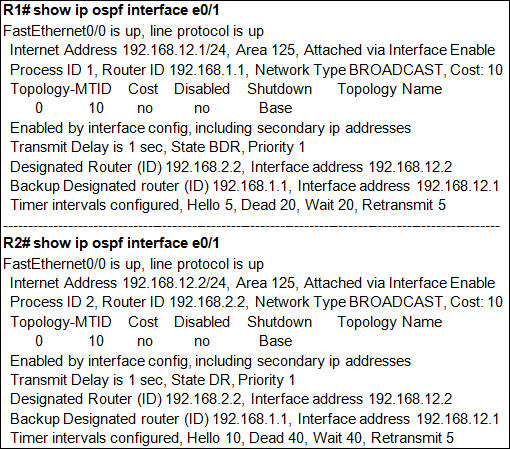
A technician configured OSPF on two routers but they cannot become neighbors. You are invited to troubleshoot the problem. After issuing the “show ip ospf interface Fa0/0” command can you tell where the problem is?
A. The OSPF process ID is mismatched
B. The hello and dead timers are mismatched
C. Two routers cannot form OSPF neighbor relationship with network type “Broadcast”
D. The IP addresses on two routers are not in the same subnet
E. The priority of two interfaces must not greater than 1
Answer: B
Explanation
B is correct because these entries must match on neighboring routers:
– Hello and dead intervals
– Area ID (Area 0 in this case)
– Authentication password
– Stub area flag
In this case Ethernet0 of R1 has Hello and Dead Intervals of 5 and 20 while R2 has Hello and Dead Intervals of 10 and 40 -> R1 and R2 cannot form OSPF neighbor relationship.
Question 4
How can a link-state protocol build its topology table? (Choose two)
A. from routing tables of other routers
B. from hello messages
C. from LSAs sent from other routers
D. from special multicast packets
E. from broadcast messages from other routers
Answer: B C
Question 5
What command allows you to view the collection of link-states in OSPF?
A. show ip ospf database
B. show ip ospf
C. show ip ospf neighbors
D. show ip route ospf
Answer: C
Question 6
Check the topology below. Which of the following statement would be the cause of an OSPF router not form adjacency with another OSPF router? (Choose two)

A. Interfaces S0/1 on two routers are configured in different areas
B. Static routing between two S0/1 interfaces need to be configured
C. The OSPF process ID on two routers need to be the same
D. The hello and dead timers on two routers are not the same
Answer: D
Explanation
To form an adjacency (become neighbor), router TUT & HQ must have the same Hello interval, Dead interval and AREA number.
Question 7
Which of the following statements are correct about the router-id in OSPF? (Choose three)
A. It is used to synchronize OSPF databases between routers
B. It is chosen randomly from the loopback and physical interfaces on the router
C. It is chosen from the highest IP address of the loopback interfaces
D. OSPF LSA Type 1 uses router-id to announce its presence
E. It is a 32-bit number
Answer: C D E
Explanation
OSPF LSA Type 1 (or Router LSA) is generated by all routers in an area to describe their directly attached links. An example below shows this type of LSA:

As you can see, the LSA Type 1 uses the router ID to advertise itself (1.1.1.1 or 2.2.2.2).
The Router ID (RID) is an IP address used to identify the router and is chosen using the following sequence:
+ The highest IP address assigned to a loopback (logical) interface.
+ If a loopback interface is not defined, the highest IP address of all active router’s physical interfaces will be chosen.
+ The router ID can be manually assigned
Question 8
Your company is running OSPF using only area 0. What are advantages of using only one area? (Choose two)
A. The types of LSAs that are sent and received are reduced
B. Increase the speed of transmission
C. increase the speed of convergence
D. reduce routing overhead because of fewer packets need to be processed
E. decrease the number of routers need to be used
F. No virtual-link is needed because of a single area
Answer: A F
Question 9
What command should you use to enable OSPF on all interfaces of a router?
A.
Router(config)#router ospf 1
Router(config-router)#network all
B.
Router(config)#router ospf 1
Router(config-router)#network 255.255.255.255 255.255.255.255 area 0
C.
Router(config)#router ospf 1
Router(config-router)#network 0.0.0.0 0.0.0.0 area 0
D.
Router(config)#router ospf 1
Router(config-router)#network 0.0.0.0 255.255.255.255 area 0
Answer: D