WAN Questions
Question 1
Which subprotocol within Point-to-Point Protocol (PPP) is responsible for negotiating authentication?
A. LCP
B. PAP
C. CHAP
D. MS-CHAP
Answer: A
Question 2
You have to configure a serial connection between a Cisco router and a non-Cisco router. Which Layer 2 protocol should you use for this connection?
A. Frame-Relay
B. PPP
C. CHAP
D. IETF
Answer: B
Question 3
Besides PPP, which is a WAN connectivity method?
A. CHAP
B. PAP
C. LAN
D. DSL
Answer: D
Question 4
What are the characteristics of PPP?
A. PPP only supports synchronous circuits
B. PPP only supports asynchronous circuits
C. PPP supports both synchronous and asynchronous circuits
D. PPP supports built-in security mechanisms
E. PPP uses DLCI number to specify the remote partner
Answer: C D
Explanation
PPP supports both synchronous (like analog phone lines) and asynchronous circuits (such as ISDN or digital links). With synchronous circuits we need to use clock rate.
Note: Serial links can be synchronous or asynchronous. Asynchronous connections used to be only available on low-speed (<2MB) serial interfaces, but now, there are the new HWICs (High-Speed WAN Interface Cards) which also support asynchronous mode. To learn more about them please visit http://www.cisco.com/en/US/prod/collateral/modules/ps5949/ps6182/prod_qas0900aecd80274424.html.
Question 5
A network administrator has just issued the “ppp authentication chap pap” command on the serial interface of his router. What is the purpose of this command?
A. This command enables authentication of both CHAP and PAP
B. The other end can choose to authenticate via CHAP or PAP
C. This command enables CHAP authentication and uses PAP as the fallback method
D. This command tells the router to use PAP before trying to use CHAP
Answer: C
Explanation
The command “ppp authentication chap pap” command indicates the CHAP authentication is used first. If it fails or is rejected by other side then uses PAP instead. If you want to use PAP first (then CHAP) you can use the “ppp authentication pap chap” command.
Question 6a
What is the role of a CSU/DSU?
A. It terminates a digital local loop
B. It terminates an analog local loop
C. It is usually a DTE device
D. It is usually a DCE device
Answer: A
Explanation
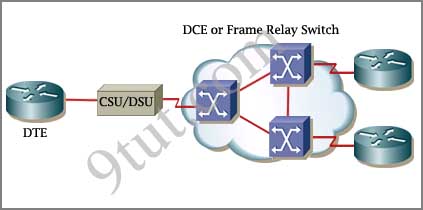
The idea behind a WAN is to be able to connect two DTE networks together through a DCE network. The network’s DCE device (includes CSU/DSU) provides clocking to the DTE-connected interface (the router’s serial interface).
Question 6b
What is the role of a modem?
A. It terminates a digital local loop
B. It terminates an analog local loop
C. It is usually a DTE device
D. It is usually a DCE device
Answer: B
Question 6c
What is the role of a router in a WAN network?
A. It terminates a digital local loop
B. It terminates an analog local loop
C. It is usually a DTE device
D. It is usually a DCE device
E. It is usually a DTE device
F. It is usually a DCE device
Answer: E
Question 7
Which of the following statements describe CHAP authentication mechanism?
A. It uses one-way handshake
B. It uses two-way handshake
C. It uses three-way handshake
D. CHAP passwords are sent in clear text
E. The authentication process is only required at the beginning of link establishment
F. The authentication process is required periodically after link establishment
Answer: C F