Subnetting Questions 2
Question 1
Check the topology below.
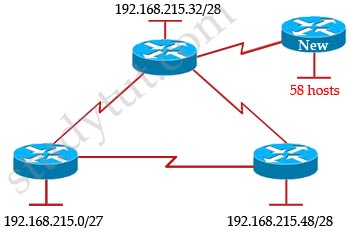
Your company has just added a new router and required a new subnet with 58 hosts. Which IP address range and subnet mask will you recommend your company to use to save addresses for other subnets?
A. 192.168.215.80/25
B. 192.168.215.80/26
C. 192.168.215.80/27
D. 192.168.215.80/28
E. 192.168.215.56/26
Answer: B
Explanation
58 hosts < 64 = 26 -> we need a subnet mask of at least 6 bit 0s -> “/26″. The question requires “save addresses for other subnets” which means we have to allow only 62 hosts-per-subnet -> B is correct.
Question 2
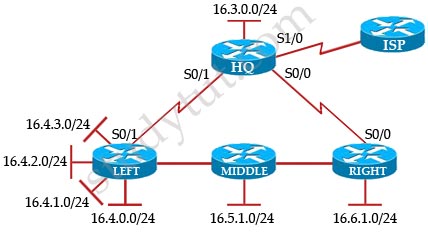
Your company has the network shown in the topology above. There are so many entries in the routing table of the HQ router so you are required so reduce its size. After investigation, you noticed the LEFT router has many subnets that can be summarized. Which entry in the routing table of HQ router shows the route summary for subnets of LEFT router without containing other subnets?
A. 16.0.0.0/20 is subnetted, 1 subnet
D 16.0.0.0[90/85384391] via 16.10.10.2 5w4d, Serial0/1
B. 16.0.0.0/21 is subnetted, 1 subnet
D 16.4.0.0[90/85384391] via 16.10.10.2 5w4d, Serial0/1
C. 16.0.0.0/22 is subnetted, 1 subnet
D 16.4.0.0[90/85384391] via 16.10.10.2 5w4d, Serial0/1
D. 16.0.0.0/23 is subnetted, 1 subnet
D 16.4.0.0[90/85384391] via 16.10.10.2 5w4d, Serial0/1
E. 16.0.0.0/24 is subnetted, 1 subnet
D 16.4.0.0[90/85384391] via 16.10.10.2 5w4d, Serial0/1
F. 16.0.0.0/20 is subnetted, 1 subnet
D 16.4.0.0[90/85384391] via 16.10.10.2 5w4d, Serial0/1
Answer: C
Explanation
All the above networks can be summarized to 16.0.0.0 network but the question requires to summarize “for subnets of LEFT router without containing other subnets” so we must summarized to 16.4.0.0 network. The LEFT router has 4 subnets so we need to “move left” 2 bits of “/24″-> /22 is the best choice -> C is correct.
Question 3
What is the best summarization for the routes below?
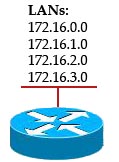
A. 172.16.0.0/21
B. 172.16.0.0/22
C. 172.16.0.0/23
D. 172.16.0.0/24
Answer: B
Explanation
We need to summarize 4 subnets so we have to move left 2 bits (22 = 4). In this question we can guess the initial subnet mask is /24 because 172.16.0.0, 172.16.1.0, 172.16.2.0, 172.16.3.0 belong to different networks. So “/24″ moves left 2 bits -> /22.
Question 4
You are hired to design the network range for LAKE company. The company requires a minimum of 400 subnets and each subnet should have a minimum of 60 hosts. This company has been allocated a class B address. Which subnet mask will you recommend for the company?
A. 255.255.255.0
B. 255.255.255.128
C. 255.255.255.240
D. 255.255.128.0
E. 255.255.255.192
F. 255.255.128.0
G. 255.255.192.0
Answer: B E
Explanation
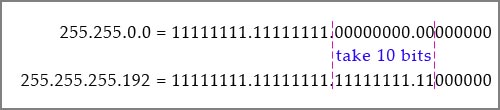
We need to remember the default subnet mask of class B is 255.255.0.0. Next, the company requires a minimum of 400 sub-networks so we have to use at least 512 sub-networks (because 512 is the minimum power of 2 and greater than 400). Therefore we need to get 9 bits for network mask (29=512), leaving 7 bits for hosts which is 27= 128 > 60 hosts per subnet.This scheme satisfies the requirement -> B is correct.
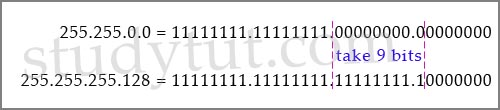
We can increase the sub-networks to 1024 ( 1024 = 210), leaving 6 bits for hosts that is 26= 64 > 60 hosts. This scheme satisfies the requirement, too -> E is correct.
Question 5
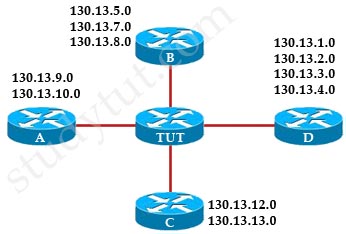
Which address range should you use to efficiently summary the routing table of TUT router?
A. 130.13.1.0/20
B. 130.13.8.0/20
C. 130.13.0.0/20
D. 130.13.0.0/22
E. 130.13.1.0/19
F. 130.13.0.0/21
Answer: C
Explanation
To summarize these networks efficiently we need to find out a network that “covers” from 130.13.1.0 -> 130.13.13.0 (including 13 networks < 16). So we need to use 4 bits (24 = 16). Notice that we have to move the borrowed bits to the left (not right) because we are summarizing.
The network 130.13.0.0 belongs to class B with a default subnet mask of /16 but in this case it has been subnetted with a subnet mask of /24 (we can guess because 130.13.1.0, 130.13.2.0, 130.13.3.0… are different networks).
Therefore “move 4 bits to the left” of “/24″ will give us “/20″ -> C is the correct answer.
Question 6
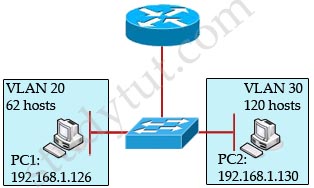
From the exhibit, could you describe the addressing scheme used in this network? (Choose three)
A. This network uses the subnet mask of 255.255.255.128
B. This network uses the subnet mask of 255.255.255.224
C. Host in VLAN 20 can be assigned the IP address 192.168.1.37
D. Host in VLAN 30 can be assigned the IP address 192.168.1.37
E. For different VLANs communication, the router must be configured with subinterfaces and multiple IP addresses
F. For different VLANs communication, the router must be configured with a single IP address
Answer: A C E
Explanation
First we should notice that different VLANs must use different sub-networks. In this case PC1 (192.168.1.126) and PC2 (192.168.1.130) are in different VLANs and must use different sub-networks. Therefore the subnet mask in use here should be 255.255.255.128. In particular, it is 192.168.1.0/25 with 2 sub-networks:
+ Sub-network 1: 192.168.1.0 -> 192.168.1.127 (assigned to VLAN 20)
+ Sub-network 2: 192.168.1.128 -> 192.168.1.255 (assigned to VLAN 30)
-> A is correct.
The IP address 192.168.1.37, which is in the same sub-network with PC1 so it can be assigned to VLAN 20 -> C is correct.
To make different VLANs communicate with each other we can configure sub-interfaces (with a different IP address on each interface) on the LAN interface of the router -> E is correct.
Question 7
You are required to divide a class C address block into seven LANs. What is the maximum number of usable host IP addresses per LAN if we do not use subnet 0?
A. 4
B. 14
C. 28
D. 30
E. 32
F. 60
Answer: D
Explanation
“You are required to divide a class C address block into seven LANs” means we have 7 subnets < 8 = 23, so we need to borrow 3 bits from the host part (to create 8 subnets). We are using class C address block which has 8 bits 0 (the default subnet mask of class C is 255.255.255.0), so the number of bit 0 left is 8 – 3 = 5. Therefore the hosts per subnet will be 25 – 2 = 30 -> D is correct.
Question 8
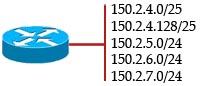
Check the topology below. What is the best subnet this router can summarize to advertise to another router?
A. 150.2.0.0/22
B. 150.2.4.0/22
C. 150.2.0.128/22
D. 150.2.8.0/22
E. 150.2.4.0/23
F. 150.2.4.0/21
Answer: B
Explanation
Network 150.2.4.0/25 and network 150.2.4.128/25 can be grouped to a single network 150.2.4.0/24.
Network 150.2.4.0/24 + Network 150.2.5.0/24 + Network 150.2.6.0/24 + Network 150.2.7.0/24 can be grouped to a single network 150.2.4.0/22 because we have all 4 subnetworks so we can move left 2 bits (22=4).
Question 9
The below output is taken from a router with the “show ip route” command.
| 10.146.8.0/30 is subnetted, 4 subnets D 10.146.8.16 [90/1823638] via 10.1.1.5, 00:00:04, Serial1/1 D 10.146.8.20 [90/2681856] via 10.1.1.5, 00:00:04, Serial1/1 D 10.146.8.24 [90/3837233] via 10.1.1.5, 00:00:04, Serial1/1 D 10.146.8.28 [90/8127323] via 10.1.1.5, 00:00:04, Serial1/1 C 10.146.8.4/30 is directly connected, Serial0/1 |
What is the best summarized address for the subnets learned by EIGRP?
A. 10.146.8.0/28
B. 10.146.8.16/28
C. 10.146.8.20/28
D. 10.146.8.16/27
E. 10.146.8.20/29
F. 10.146.8.0/27
Answer: B
Explanation
We have 4 routes learned by EIGRP:
D 10.146.8.16 [90/1823638] via 10.1.1.5, 00:00:04, Serial1/1
D 10.146.8.20 [90/2681856] via 10.1.1.5, 00:00:04, Serial1/1
D 10.146.8.24 [90/3837233] via 10.1.1.5, 00:00:04, Serial1/1
D 10.146.8.28 [90/8127323] via 10.1.1.5, 00:00:04, Serial1/1
These subnets are all /30 (as it says “10.146.8.0/30 is subnetted, 4 subnets”. We have 4 successive subnets = 22 so we can go back 2 bits -> the summarized subnet mask is 30 – 2 = 28 and the summarized network is 10.146.8.16/28.