IP Address Questions
Question 1
Which class of IP address space does the IP address 12.1.1.3 belong to ?
A. Class A
B. Class B
C. Class C
D. Class D
Answer: A
Explanation
The table below summarizes the ranges of IP address class A, B and C with their default subnet masks.
| Default subnet mask | Range | |
| Class A | 255.0.0.0 (/8) | 1.0.0.0 – 126.255.255.255 |
| Class B | 255.255.0.0 (/16) | 128.0.0.0 – 191.255.255.255 |
| Class C | 255.255.255.0 (/24) | 192.0.0.0 – 223.255.255.255 |
From this table we can see IP address 12.1.1.3 belongs to class A.
Question 2
You are tasked to choose an IP address to go to the Internet on your router. Which of the following IP address can do this task?
A. 10.6.4.5
B. 8.5.6.2
C. 172.16.123.1
D. 192.168.1.223
Answer: B
Explanation
The IP address which can be assigned to an Internet interface is a public IP address. Private IP address are found in the following ranges:
* From 10.0.0.0 to 10.255.255.255
* From 172.16.0.0 to 172.31.255.255
* From 192.168.0.0 to 192.168.255.255
Also some special IP addresses (like the local loopback address 127.0.0.1, multicast addresses…) can’t be assigned to an Internet interface.
In this question only answer B doesn’t belong to the range of private IP address -> B is the correct answer.
Question 3
Your colleague has just assigned the IP address 10.10.10.1 to an interface on a router which is directly connected to the Internet. What will be the result of this action?
A. It is a private IP address so it cannot be not routed on the Internet.
B. The router can access the Internet
C. The router will automatically convert this IP address to a public IP address by NAT
D. The router will inform an IP address conflict and the router cannot access the Internet
Answer: A
Explanation
The IP address 10.10.10.1 is a private IP address and it can’t access the Internet. You usually need to manually configure Network Address Translation (NAT) to convert it into a public IP address before sending packets to the Internet.
Question 4
Your server has just been setup with TCP/IP stack. You want to ping the loopback IP address of this server. Which IP address should you ping?
A. 10.10.10.10
B. 1.1.1.1
C. 192.168.1.1
D. 127.0.0.1
E. 0.0.0.0
Answer: D
Explanation
The IP address of 127.0.0.1 is the well-known loopback IP address on a computer. When try pinging this address, you are testing if the TCP/IP stack is working or not.
Question 5
Check the topology below.
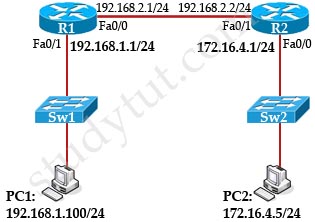
Which value will be configured for Default Gateway of PC1 so that PC1 can communicate with PC2?
A. 192.168.1.1
B. 192.168.1.2
C. 172.16.4.1
D. 172.16.4.2
Answer: A
Explanation
PC1 (192.168.1.100) and PC2 (172.16.4.5) are in different networks so they need to have a default gateway to communicate with each other. In this topology only router R1 can help PC1 to reach PC2 as router is a Layer 3 device and is responsible for sending/receiving packets from different networks.
Question 6
Checking the IP address assignment in the topology below.
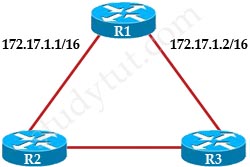
What conclusions can be made about this IP address assignment?
A. There is no problem with this assignment
B. The router will not accept this IP address assignment.
D. The connection between routers should be configured as trunks.
E. The router interfaces must be encapsulated with the 802.1Q protocol.
Answer: B
Explanation
Each interface on a router must be in a different network. If two interfaces are in the same network, the router will not accept it and show error when the administrator assigns it. In this case two interfaces on R1 are assigned IP addresses 172.17.1.1/16 and 172.17.1.2/16 which are in the same network -> R1 will not accept this IP address assignment.
Question 7
Which two statements describe the IP address 190.15.34.46/24? (Choose two)
A. The subnet mask of this IP address is 255.255.255.0.
B. The subnet mask of this IP address is 255.255.0.0.
C. This is a class B IP address
D. This is a class C IP address
Answer: A C
Explanation
The table below summarizes the ranges of IP address class A, B and C with their default subnet masks.
| Default subnet mask | Range | |
| Class A | 255.0.0.0 (/8) | 1.0.0.0 – 126.255.255.255 |
| Class B | 255.255.0.0 (/16) | 128.0.0.0 – 191.255.255.255 |
| Class C | 255.255.255.0 (/24) | 192.0.0.0 – 223.255.255.255 |
From this table we can see IP address 190.15.34.46 belongs to class B. But please notice that it is not using class B default subnet mask (/16). It is using /24, which is 255.255.255.0 subnet mask. “/24” here means 24 bits 1 written successively at the left of a subnet mask in binary form (which is 1111 1111.1111 1111 1111.1111 1111.0000 0000). After converting it into decimal form we get 255.255.255.0.
Question 8
What are the network address and broadcast address of the network 192.9.10.2/24?
A. 192.9.10.255
B. 192.9.255.255
C. 192.9.10.0
D. 192.9.0.0
E. 192.0.0.0
F. 192.255.255.255
Answer: A C
Explanation
From the subnet mask /24 (255.255.255.0) we learn that the major network of this IP address is 192.9.10.0/24 (keep the first 24 bits of this IP address and replace the rest with bit 0). Therefore the network address of this network is 192.9.10.0 and the broadcast address is 192.9.10.255.