STP Questions
Question 1
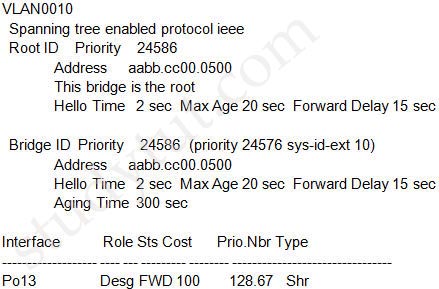
From the output below, what is the role of Switch1 for VLAN 10?
Switch1#show spanning-tree vlan 10
A. alternative switch
B. root bridge
C. main switch
D. main bridge
E. redundant switch
Answer: B
Explanation
From the “This bridge is the root” line we can conclude this switch is the root bridge for VLAN 10.
Note: Here the term “bridge” and “switch” are used interchangeable.
Question 2
What values does Spanning Tree Protocol use to elect a root bridge? (Choose two)
A. MAC address
B. IP address
C. Bridge Priority
D. IOS version
E. CPU speed
Answer: A C
Explanation
Spanning Tree Protocol (STP) uses the Bridge ID to elect a root bridge. The lower value of the Bridge ID, the higher priority it has to become a root bridge. The Bridge ID is composed of the bridge priority value (0-65535, 2 bytes) and the bridge MAC address (6 bytes).
Bridge ID = Bridge Priority + MAC Address
For more information about how STP elects a root bridge, please read our STP tutorial.
Question 3
Which STP states were replaced with the Rapid STP (RSTP)? (Choose three)
A. learning
B. listening
C. blocking
D. forwarding
E. disabled
Answer: B C E
Explanation
The table below compares the traditional STP and RSTP states:
| STP State (802.1d) | RSTP State (802.1w) |
| Blocking | Discarding |
| Listening | Discarding |
| Learning | Learning |
| Forwarding | Forwarding |
| Disabled | Discarding |
From this table we can see that Blocking, Listening and Disabled states in STP are replaced with Discarding state in RSTP.