IP Routing
Question 1
If a router has multiple sources to reach the destination, which of the following paths will it choose to send the packets?
A. From an OSPF update
B. From a static configured route
C. From an EIGRP update
D. From a RIP update
E. From a directly connected interface with an IP address in the same subnet with the destination
F. From a default route
Answer: E
Question 2
Check the topology below, PC1 and the Server is communicating. What will the source MAC address of the packet PC1 receive from the Server?
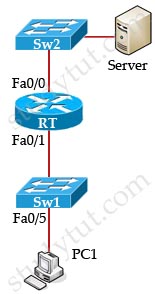
A. the MAC address of PC1
B. the MAC address of Server
C. the MAC address of Fa0/0 interface of the Router
D. the MAC address of Fa0/1 interface of the Router
Answer: D
Question 3
A router has learned about a destination via multiple routing protocols. Which routing protocol will the router use to reach the destination?
A. OSPF
B. EIGRP
C. RIPv2
D. RIPv1
E. The router will load balance the traffic among these routing protocols
F. OSPF and EIGRP
Answer: B
Explanation
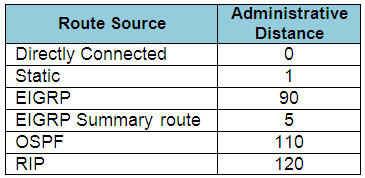
When one route is advertised by more than one routing protocol, the router will choose to use the routing protocol which has lowest Administrative Distance. The Administrative Distances of popular routing protocols are listed below:
Question 4
Check the topology below

Your company wants to configure a static route to network 192.168.1.0/24 on TUT router. What command will you use to complete this task? (Choose two)
A. TUT(config)#ip route 192.168.1.0 0.0.0.255 Serial0/1
B. TUT(config)#ip route 192.168.1.0 255.255.255.0 Serial0/1
C. TUT(config)#ip route 192.168.1.0 0.0.0.255 Serial0/2
D. TUT(config)#ip route 192.168.1.0 255.255.255.0 Serial0/2
E. TUT(config)#ip route 192.168.1.0 255.255.255.0 192.168.2.1
F. TUT(config)#ip route 192.168.1.0 255.255.255.0 192.168.2.2
Answer: B F
Explanation
The simple syntax of static route:
ip route destination-network-address subnet-mask {next-hop-IP-address | exit-interface}
+ destination-network-address: destination network address of the remote network
+ subnet mask: subnet mask of the destination network
+ next-hop-IP-address: the IP address of the receiving interface on the next-hop router
+ exit-interface: the local interface of this router where the packets will go out
In the statement “ip route 192.168.1.0 255.255.255.0 Serial0/1″:
+ 192.168.1.0 255.255.255.0: the destination network
+ Serial0/1: the exit-interface
Question 5
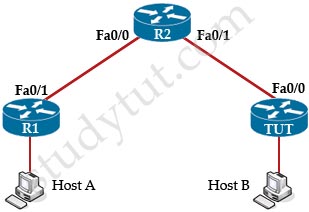
A host is pinging interface s0/0 on TUT router, what is the TTL of the ping when it reach this interface?
A. 255
B. 254
C. 253
D. 252
E. 251
Answer: C
Explanation
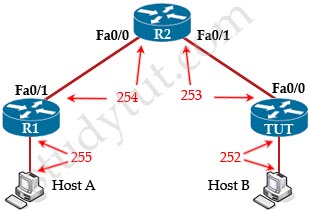
From the CCNA ICND2 Exam book: “Routers decrement the TTL by 1 every time they forward a packet; if a router decrements the TTL to 0, it throws away the packet. This prevents packets from rotating forever”. For example in the topology above, pings to S0/1 and S0/0 of Router 2 have the same TTL.
The picture below shows TTL values for each interface of each router and for Host B. Notice that Host A initializes ICMP packet with a TTL of 255:
Question 6
What commands are used to set the “gateway of last resort” to the current default gateway on a router, suppose that ip routing is enabled?
A. ip default-gateway 10.0.0.1
B. ip route 0.0.0.0 0.0.0.0 10.0.0.1
C. ip default-network 0.0.0.0
D. ip default-gateway 0.0.0.0
E. ip default-network 10.0.0.1
Answer: B C
Explanation
Please visit http://www.cisco.com/c/en/us/support/docs/ip/routing-information-protocol-rip/16448-default.html
Question 7
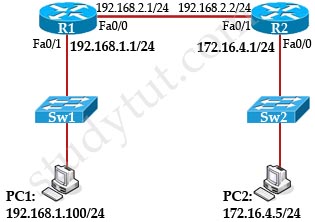
| C:\> ping 172.16.4.5 Pinging 172.16.4.5 with 32 bytes of data: Reply from 192.168.1.1: Destination host unreachable. |
PC1 is trying to ping PC2 and receives the result as shown below. What may cause this issue?
A. The port connecting to PC1 on Sw1 is shut down
B. The port connecting to R1 on Sw1 is shut down
C. Interface Fa0/1 on R1 is faulty
D. Interface Fa0/1 on R2 is shut down
E. PC1 is not using TCP/IP
F. R1 does not know how to reach PC1
Answer: D
Explanation
In this question, PC1 wants to ping PC2 but it receives a reply from the interface Fa0/1 of Router1 (192.168.1.1/24) that the “destination host unreachable”.
If the link between PC1 and Sw1 is down or the link between Sw1 and R1 is down then PC1 can not receive this reply -> A, B and F are not correct.
Interface Fa0/1 on R1 replies for the ping packets from Host1 so it is up (TCP/IP is running correctly) -> E is not correct. If the interface Fa0/1 on R1 is shutdown then we will receive a message of “Request timed out”, not “Destination host unreachable”.
Answer D is correct because we can get a reply from the interface Fa0/1 of R1 so the link between PC1 and R1 should be fine -> the problem lies at the other side of R1. But if the link between R2 and PC2 is down then we will receive a reply from interface Fa0/1 of R2 that the “destination host unreachable”. Therefore the problem can just be at the link between R1 and R2.
Question 8
Checking the topology below.
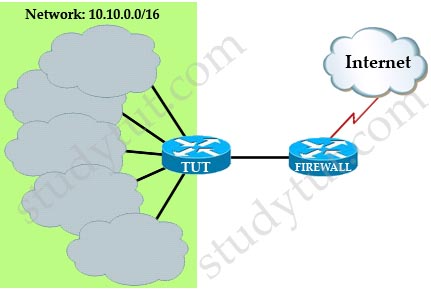
There are many subnets of the network 10.10.0.0/16 are implemented behind TUT router. What are the simplest configuration on the TUT and FIREWALL routers so that their routing tables are minimal and easy to understand? (Choose two)
A. Configure OSPF on FIREWALL router to advertise summarized routes to TUT router
B. Configure OSPF on TUT router to advertise summarized routes to FIREWALL router
C. Configure a default route on TUT router to send traffic to FIREWALL router
D. Configure a static route on FIREWALL router that sends all traffic to network 10.10.0.0/16 to TUT router
E. Configure OSPF on both routers so that they can learn all the subnets behind TUT router
Answer: C D