IP Routing 2
Question 1
You have just received a report that your users on 192.168.1.0 cannot get resources on the server at 192.168.200.0. You are now accessing TUT router to perform some check with the show ip route command. This is the output:
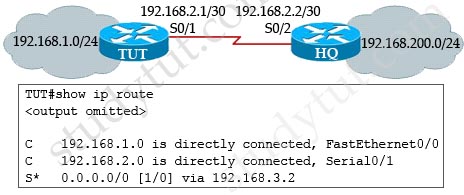
Based on the output, what is the root of this issue?
A. TCP/IP is not implemented on TUT router
B. The Serial connection between the two routers is having problem
C. An incorrect static route has been configured on TUT router
D. Router HQ does not know how to reply users on 192.168.1.0
E. TUT router is missing “ip routing” command
F. TUT router did not recognize its neighbor
Answer: C
Explanation
From the last line “S* 0.0.0.0/0 [1/0] via 192.168.3.2” we can see that the destination of the default route configured on TUT router is 192.168.3.2. Therefore if TUT router receives a packet with destination IP address of 192.168.200.0/24, it will use this default route (because no other entries are matched) and sends the packet to 192.168.3.2 while it should be 192.168.2.2 (IP address of S0/2 of HQ router).
Question 2
Check the topology below.
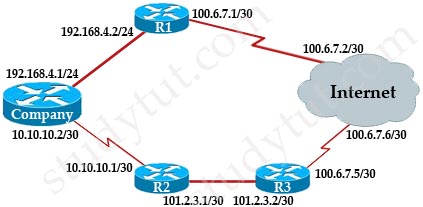
Your company hired two Internet connections to increase availability as shown in the topology. You are tasked to configure a route to the Internet for users on the Company LAN via the most direct path. The speed of serial link is E1 and the speed of Ethernet link is 100Mbps. What command will you use to complete this task?
A. ip route 0.0.0.0 0.0.0.255 192.168.4.2
B. ip route 0.0.0.0 0.0.0.0 192.168.4.2
C. ip route 0.0.0.0 255.255.255.255 10.10.10.1
D. ip route 0.0.0.0 0.0.0.0 10.10.10.1
E. ip route 0.0.0.0 0.0.0.0 10.10.10.2
F. ip route 0.0.0.0 255.255.255.255 10.10.10.2
Answer: B
Explanation
“The most direct path” here means via R1 because it is directly connected with the Internet while the R2 path needs to go through R3. So we need a command to send traffic to R2 and the correct command is “ip route 0.0.0.0 0.0.0.0 192.168.4.2″.
Question 3
Your colleague is hesitating in choosing between static or dynamic routing. What will you tell him about the benefits of static routing over dynamic routing?
A. The routing table will be updated automatically when network topology changes
B. Increase network security as only the administrator of that router can alter the routing table
C. Reduce complexity of configuration when the network topology grows
D. Static routing will be sent automatically to other routers in the same network
E. Reduce routing updates and traffic load in stub networks
Answer: B E
Explanation
By using static routing, your router does not have information about the entire networks so it is safer and increase security for the network. Also static routing requires all entries in the routing table must be configured manually by the networking administrator.
Another advantage of static routing is that it does not require routing updates (which are very important for dynamic routing to learn the topology). Therefore it can reduce routing updates in a router. Especially, static routing is often used in stub router (the router that only has one exit point to outside) to reduce unnecessary routing updates.
Question 4
Which of the following paths will the router choose to send a packet with destination IP of 192.168.100.130?
A. 192.168.100.0/24 via 10.1.1.1, 00:00:29, Serial1/0
B. 192.168.100.128/25 via 10.1.2.1, 00:00:29, Serial1/1
C. 192.168.100.128/26 via 10.1.3.1, 00:00:29, Serial1/2
D. 192.168.100.128/27 via 10.1.4.1, 00:00:29, Serial1/3
Answer: D
Explanation
The destination IP address 10.1.5.65 belongs to all four answers (192.168.100.0/24, 192.168.100.128/25, 192.168.100.128/26 & 192.168.100.128/27 subnets but the “longest prefix match” algorithm will choose the most specific subnet mask -> the prefix “/27″ will be chosen to route the packet. Therefore the next-hop should be 10.1.4.1 -> D is correct.
Question 5
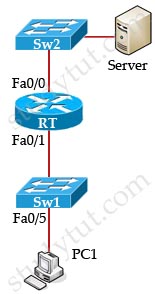
What destination addresses PC1 will use to send traffic to Server?
 A. the IP address of Fa0/0 of the router
B. the IP address of Fa0/1 of the router
C. the IP address of Server
D. the MAC address of Server
E. the MAC address of Fa0/0 of the router
F. the MAC address of Fa0/1 of the router
Answer: C F
Explanation
While transferring data through many different networks, the source and destination IP addresses are not changed. Only the source and destination MAC addresses are changed. So in this case PC1 will use the IP address of Server and the MAC address of Fa0/1 interface to send data. When the router receives this data, it replaces the source MAC address with it own Fa0/0 interface’s MAC address and replaces the destination MAC address with Server’s MAC address before sending to Server -> C and F are correct.
Question 6
Check the topology below
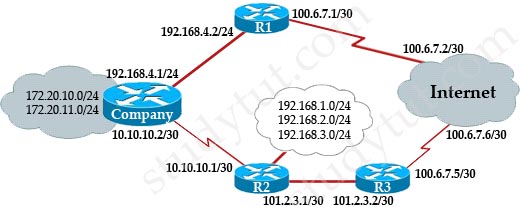
What is the simplest way to establish a route so that users in Company can send data to users in R2?
A. Configure OSPF on Company router to advertise routes to R2 router
B. Configure EIGRP on R2 router to advertise routes to Company router
C. Configure a dynamic routing protocol and inject a default route on R2 router to advertise that route to Company router
D. Configure a static route on Company router to send all traffic destined for 192.168.0.0/22 to 10.10.10.1
E. Configure a static route on R2 router to send all traffic destined for 172.20.1.0/23 to Company router
Answer: D
Question 7
Your network is using one static routing protocol and one dynamic routing protocol to reach a network. How can you influence the router to prefer dynamic to static routing protocol?
A. By bandwidth
B. By cost
C. By administrative distance
D. By MTU
E. By delay
Answer: C
Explanation
By default, static routing protocol has lower administrative distance than dynamic routing protocol so routers always prefers using static routing protocol. To change this behavior we have to increase the administrative distance of the static routing protocol (to a higher value than that of the dynamic routing protocol). For example, we can increase the value of administrative distance of a static route to 100 by this command:
Router(config)#ip route 10.0.0.0 255.255.255.0 15.1.1.1 100
Question 8
Check the topology below.
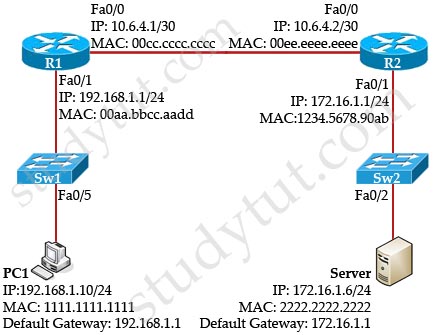
After PC1 pings Server, what entry will be put in the ARP cache of PC1 for this communication? (Choose two)
A. Interface Address: 192.168.1.1
B. Interface Address: 10.6.4.2
C. Interface Address: 172.16.1.6
D. Physical Address: 00aa.bbcc.aadd
E. Physical Address: 1234.5678.90ab
F. Physical Address: 2222.2222.2222
Answer: A D
Explanation
PC1 knows Server is in another network so it will send the pings to its default gateway 192.168.1.1. PC1 sends a broadcast frame asking the MAC address of 192.168.1.1. These information (IP and MAC address of the default gateway) is saved in its ARP cache for later use.
Question
Which of the following statements are correct about the command “ip route 192.168.1.0 255.255.255.0 10.10.10.1”? (Choose two)
A. All traffic on the router is sent to the destination IP address 10.10.10.1
B. Traffic destined for network 192.168.1.0/24 is routed to 10.10.10.1
C. Traffic destined for 10.10.10.1 is routed to the 192.168.1.0/24 network
D. This static route uses default administrative distance
Answer: B D