Frame Relay 2
Question 1
Which of the following statements about Frame Relay Point-to-Point subinterfaces are correct? (Choose two)
A. Each subinterface requires a different subnet
B. Point-to-Point subinterfaces work similarly to lease lines
C. Split-horizon issues need to be addressed
D. Before implementing dynamic routing protocols, they must be set to NBMA media
E. They are used in full mesh topologies
Answer: A B
Question 2
Which of the following assignments of DLCIs and IP addresses for the point-to-point Frame Relay is correct?
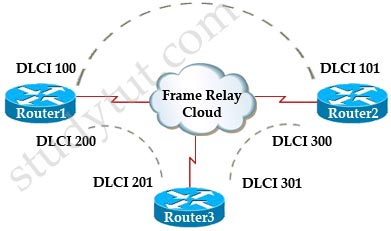
<Redraw 16->100;17->200;99-> 60;28->30>
A.
DLCI 100: 172.16.100.1/24
DLCI 200: 172.16.100.2/24
DLCI 101: 172.16.100.3/24
DLCI 201: 172.16.100.4/24
B.
DLCI 100: 172.16.100.1/24
DLCI 200: 172.16.101.2/24
DLCI 101: 172.16.102.3/24
DLCI 201: 172.16.103.4/24
C.
DLCI 100: 172.16.100.1/24
DLCI 200: 172.16.101.2/24
DLCI 101: 172.16.100.3/24
DLCI 201: 172.16.101.4/24
D.
DLCI 100: 172.16.100.1/24
DLCI 200: 172.16.100.2/24
DLCI 101: 172.16.100.3/24
DLCI 201: 172.16.101.4/24
Answer: C
Question 3
A colleague asks what you can learn from the output of the “show frame-relay map” command. What will you answer him? (Choose two)
A. The local DLCI number
B. The IP address of the router
C. The transmission rate of the interface
D. The status of the Frame Relay link configured on the router
E. The number of errors occurred on the Frame Relay link
Answer: A D
Explanation
An example of the output of this command is shown below:

From the output we can see the local DLCI (102 & 103) and the status of the PVC configured on the router (both are defined, active).
Question 4
Your company is using a Serial connection to communicate to a branch via PPP. But now your company is planning to replace PPP with Frame Relay. What should be re-configured for this replacement? (Choose three)
A. configure a static frame relay map on each subinterface
B. delete the IP address on the main physical interface
C. Create subinterfaces for each Frame Relay connection
D. Each subinterface must be configured with a different subnet
E. Set the encapsulation on each subinterface to Frame Relay
Answer: B C D
Explanation
To configure subinterface for Frame Relay, first we have to remove the IP address from the physical interface and choose a Frame Relay encapsulation. An example of configuring Frame Relay on a subinterface is shown below:
interface Serial0/1.12 point-to-point
ip address 10.1.1.2 255.255.255.252
frame-relay interface-dlci 304
Question 5
What are Frame Relay encapsulation types supported in Cisco routers? (Choose two)
A. Cisco
B. 802.3d
C. IETF
D. LMI
E. BECN
Answer: A C
Explanation
Cisco supports two Frame Relay encapsulation types: the Cisco encapsulation and the IETF Frame Relay encapsulation, which is in conformance with RFC 1490 and RFC 2427. The former is often used to connect two Cisco routers while the latter is used to connect a Cisco router to a non-Cisco router. You can test with your Cisco router when typing the command Router(config-if)#encapsulation frame-relay ? on a WAN link. Below is the output of this command (notice Cisco is the default encapsulation so it is not listed here, just press Enter to use it).

Note: Three LMI options are supported by Cisco routers are ansi, Cisco, and Q933a. They represent the ANSI Annex D, Cisco, and ITU Q933-A (Annex A) LMI types, respectively.
HDLC is a WAN protocol same as Frame-Relay and PPP so it is not a Frame Relay encapsulation type.
Question 6
What is the meaning of the “frame-relay map ip 10.0.0.1 103 broadcast” interface command?
A. inform other Frame Relay routers in the network to use DLCI 103 to send traffic to 10.0.0.1
B. broadcast the IP 10.0.0.1 to all Frame Relay neighbors
C. DLCI 103 should be used for all data sent from 10.0.0.1
D. DLCI 103 should be used for all data sent to 10.0.0.1
Answer: D