Basic Questions
Question 1
How many broadcast domains and collision domains in the network shown below?
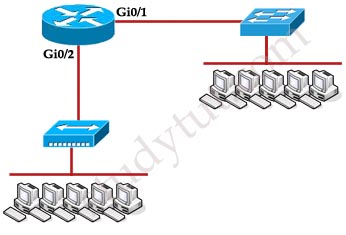 A. Two broadcast domains
B. Three broadcast domains
C. Four broadcast domains
D. Two collision domains
E. Seven collision domains
F. Nine collision domains
Answer: A E
Question 2
Refer to the output:
| System flash director …… [2658271 bytes used,10947492 available, 13605763 total] 4096K bytes of processor board System flash(Read/Write) |
Suppose you want to upload a new IOS to the router but still want to keep the existing IOS on it. What is the maximum size (in MB) of the new IOS file so that both can be kept in the router?
A. 1 MB
B. 4 MB
C. 10 MB
D. 12 MB
Answer: C
Explanation
From the exhibit we learn there are 10947492 bytes (over 10MB) available so it is only enough space for an IOS file of 10MB. If bigger file is copied then the existing IOS file will be erased (overwritten).
Question 3
Checking the output of the “show interfaces E0/0” below. What does the line “MTU 1500 bytes” mean?
| Router#show interfaces ethernet1/0 Ethernet1/0 is up, line protocol is up Hardware is AmdP2, address is aabb.cc00.0100 (bia aabb.cc00.0100) Internet address is 10.1.1.17/30 MTU 1500 bytes, BW 10000 Kbit/sec, DLY 1000 usec, reliability 255/255, txload 1/255, rxload 1/255 |
A. 1500 is the maximum number of bytes per second are allowed to pass through this this interface.
B. 1500 is the minimum number of bytes per second are allowed to pass through this interface.
C. 1500 is the maximum segment size are allowed to pass through this interface.
D. 1500 is the maximum frame size are allowed to pass through this interface.
E. 1500 is the maximum packet size that is allowed to pass through this interface.
Answer: E
Question 4
You have just detected a device whose interface ports have collision detection and carrier sensing enabled on the shared twisted pair environment. What conclusion can be deduced from this interface?
A. It is a Serial interface
B. It is a 100Mbps interface
C. It is an Ethernet interface which operates at half duplex
D. It is an Ethernet interface which operates at full duplex
E. This interface is faulty
Answer: C
Explanation
Modern Ethernet networks built with switches and full-duplex connections no longer utilize CSMA/CD. CSMA/CD is only used in obsolete shared media Ethernet (which uses repeater or hub).
Question 5
What conditions must be met so that a device can transmit in the Ethernet medium? (Choose two)
A. When it is granted to do so
B. When it detects a carrier
C. When it detects no other devices are transmitting
D. When the medium is idle
E. When it has a token
F. When other devices inform it can transmit
Answer: C D
Explanation
Ethernet network is a shared environment so all devices have the right to access to the medium. If more than one device transmits simultaneously, the signals collide and can not reach the destination.
If a device detects another device is sending, it will wait for a specified amount of time before attempting to transmit.
When there is no traffic detected, a device will transmit its message. While this transmission is occurring, the device continues to listen for traffic or collisions on the LAN. After the message is sent, the device returns to its default listening mode.
So we can see C and D are the correct answers. But in fact “answer C – when they detect no other devices are sending” and “when the medium is idle” are nearly the same.
Question 6
Why does Ethernet protocol use physical addresses? (Choose two)
A. To identify devices at Layer 2
B. To allow two devices on different network to communicate
C. To identify devices at Layer 1
D. To quickly short the priority of each device
E. To allow two devices to communicate if they are on the same network
Answer: A E
Explanation
Physical addresses (MAC addresses) are used to identify devices at layer 2 -> A is correct.
MAC addresses are only used to communicate on the same network. To communicate on different network we have to use Layer 3 addresses (IP addresses) -> B is not correct; E is correct.
Layer 2 frame and Layer 3 packet can be recognized via headers. Layer 3 packet also contains physical address -> C is not correct.
On Ethernet, each frame has the same priority to transmit by default -> D is not correct.
All devices need a physical address to identify itself. If not, they can not communicate -> F is not correct.
Question 7
The “boot system” command used to tell the devices where to look for the IOS image. Where can this command point to?
A. NVRAM
B. RAM
C. Flash Memory
D. SNMP Server
E. TFTP Server
Answer: C E
Explanation
The following locations can be configured as a source for the IOS image with the “boot system” command:
+ Flash (the default location)
+ TFTP server
+ ROM (used if no other source is found)
Question 8
What are a CSU/DSU and a modem used for? (Choose two)
A. A CSU/DSU transforms digital signal to a leased line
B. A CSU/DSU transforms analog signal to a leased line
C. A modem transforms analog signal to a phone line
D. A modem transforms digital signal to a phone line
Answer: A D
Question 9
After the POST process is completed, the router is going to locate an IOS image. What will it perform next?
A. Check the configuration register
B. Boot from the location of “boot system” command
C. Check the NVRAM
D. Check its standard disk
Answer: A
Explanation
When you turn the router on, it runs through the following boot process.
The Power-On Self Test (POST) checks the router’s hardware. When the POST completes successfully, the System OK LED indicator comes on.
The router checks the configuration register to identify where to load the IOS image from. A setting of 0×2102 means that the router will use information in the startup-config file to locate the IOS image. If the startup-config file is missing or does not specify a location, it will check the following locations for the IOS image:
1. Flash (the default location)
2. TFTP server
3. ROM (used if no other source is found)
The router loads the configuration file into RAM (which configures the router). The router can load a configuration file from:
+ NVRAM (startup-configuration file)
+ TFTP server
If a configuration file is not found, the router starts in setup mode.