OSI & TCP/IP Model
Question 1
Based on the TCP/IP model, at what layer does routing take place?
A. Application Layer
B. Transport Layer
C. Network Layer
D. Internet Layer
Answer: D
Explanation
The picture below shows the comparison between TCP/IP model & OSI model. Notice that the Internet Layer of TCP/IP is equivalent to the Network Layer which is responsible for routing decision. 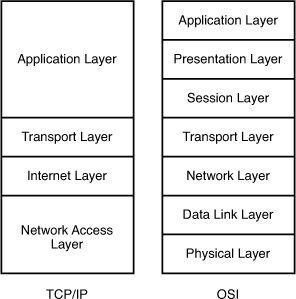 Question 2
Refer to exhibit.
| Router#show running-config ! interface FastEthernet0/1 ip address 192.168.2.10 255.255.255.0 ip access-group 200 in ! access-list 200 deny tcp any any eq 22 access-list 200 permit ip any any ! line con 0 logging synchronous login line vty 0 4 login line vty 5 14 login ! end |
Why a user cannot Telnet to this router?
A. That user is not in the same network with this router
B. Access list 101 blocked Telnet
C. VTY lines have not been configured with a password
D. The “line con 0” must be configured with “login” command
E. VTY lines must be configured with “transport input telnet” command
Answer: C
Question 3
What should be checked before installing a new IOS image and which command should be used to check?
A. the remaining of ROM
B. the remaining of flash and RAM memory
C. the remaining of NVRAM
D. show version
E. show running-config
Answer: B D
Explanation
When upgrading new version of the IOS we need to copy the IOS to the Flash so first we have to check if the Flash has enough memory or not. Also running the new IOS may require more RAM than the older one so we should check the available RAM too. We can check both with the “show version” command.
Question 4
A user tries to ping to 192.168.100.1 and see the output below. At which OSI did layer the problem occur?
| C:\> ping 192.168.100.1 Pinging 192.168.100.1 with 32 bytes of data: Request timed out. Request timed out. Request timed out. Request timed out. Packets: sent – 4, Received = 0, Lost – 4 (100% loss) |
A. Application Layer
B. Presentation Layer
C. Session Layer
D. Data Link Layer
E. Network Layer
F. Physical Layer
Answer: E
Explanation
The Network layer is responsible for network addressing and routing through the internetwork. So a ping fails, you may have an issue with the Network layer (although lower layers like Data Link & Physical may cause the problem).
Question 5
Point-to-Point Protocol (PPP) provides a standard method for transporting multi-protocol datagrams over point-to-point links. At which OSI layer does the protocol operate?
A. Data Link Layer
B. Physical Layer
C. Transport Layer
D. Session Layer
E. Application Layer
Answer: A
Question 6
Choose the correct statements about the OSI encapsulation process. (Choose two)
A. Transport layer devides data into smaller segments. Transport layer may also add flow control and reliability information.
B. Data link Layer adds source and destination MAC address and the frame check sequence (FCS) to the segment C. Network layer encapsulates a frame with source and destination IP addresses to create packets
D. Network layer encapsulates a segment with source and destination IP addresses to create packets
E. Physical layer converts a packet into bits 0 and 1
Answer: A D
Explanation
The Transport Layer segments data into smaller pieces for transport. Each segment is assigned a sequence number, so that the receiving device can reassemble the data on arrival. The Transport Layer also uses flow control to maximize the transfer rate while minimizing the requirements to retransmit. For example, in TCP, basic flow control is implemented by acknowledgment by the receiver of the receipt of data; the sender waits for this acknowledgment before sending the next part. -> A is correct.
The Data Link Layer adds physical source and destination addresses and an Frame Check Sequence (FCS) to the packet (on Layer 3), not segment (on Layer 4) -> B is not correct.
Packets are created when network layer encapsulates a segment (not frame) with source and destination host addresses and protocol-related control information. Notice that the network layer encapsulates messages received from higher layers by placing them into datagrams (also called packets) with a network layer header -> C is not correct.
The Network Layer (Layer 3) has two key responsibilities. First, this layer controls the logical addressing of devices. Second, the network layer determines the best path to a particular destination network, and routes the data appropriately. -> D is correct.
The Physical Layer (not Presentation Layer) translates bits into voltages for transmission across the physical link -> E is not correct.
Question 7
What is the highest OSI layer that an FTP connection is used to connect to a server?
A. Application Layer
B. Session Layer
C. Presentation Layer
D. Transport Layer
E. Network Layer
F. Data Link Layer
Answer: A
Explanation
FTP belongs to Application layer and it is also the highest layer of the OSI model.
Question 8
A colleague asks you at which layer the Rapid Spanning-tree Protocol (RSTP) operates. You will answer:
A. Application Layer
B. Transport Layer
C. Network Layer
D. Data Link Layer
E. Physical Layer
Answer: D
Question 9
Which OSI layer is responsible for determining the identity and availability of communication partners for an application with data to transmit?
A. Application Layer
B. Session Layer
C. Presentation Layer
D. Transport Layer
E. Network Layer
F. Data Link Layer
Answer: A
Question 10
At which OSI layer does a frame checksum is performed ?
A. Transport Layer
B. Session Layer
C. Presentation Layer
D. Data Link Layer
E. Network Layer
F. Application Layer
Answer: D
Explanation
When using the term “frame” we can easily recognize it belongs to the Data Link layer. In this layer, an Frame Check Sequence (FCS) field is added to the frame to verify that the frame data is received correctly.