Trunking Questions
Question 1
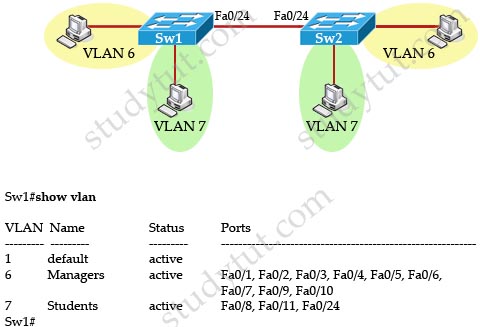
Your company network is having problem. Users in VLAN 6 on Sw1 cannot communicate with users in VLAN 6 on Sw2 but users in VLAN 7 on Sw1 can communicate normally with users on VLAN 7 on Sw2. The VLAN assignment configuration are identical on Sw1 and Sw2. What might cause this problem?
 A. The Fa0/24 interface is not working correctly on a switch
B. The Fa0/24 interface is not configured as trunk on Sw1
C. VLAN 1 does not have any ports in it and this cause problem
D. A router must be implemented so that users in VLAN 7 on two switches can communicate
E. The Fa0/24 must be configured in access mode
Answer: B
Explanation
The show vlan command only displays access ports, the trunk ports are not shown in this command (we can use the “show interface trunk” command to see trunked ports). In the output we can see the ports Fa0/24 connecting between two switches in VLAN 7 -> they are access ports and only VLAN 7 can communicate. To make all VLANs can communicate (with the same VLAN at the other switch), the link between two switches must be set as trunk -> B is correct.
Question 2
What is the IEEE 802.1Q used for?
A. A protocol of EtherChannel
B. A method of VLAN tagging
C. A protocol of VLAN trunking
D. A method of describing MAC address
E. The Spanning-Tree Protocol
Answer: C
Question 3
What are the three modes of a VLAN trunk? (Choose three)
A. on
B. desirable
C. auto
D. alternative
E. forwarding
F. waiting
Answer: A B C
Question 4
Refer to the topology below
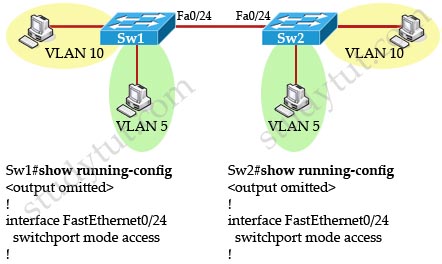 None of the users on Sw1 can communicate with users on the same VLAN on Sw2. Suppose all the switch ports are correctly assigned to suitable VLANs. What might be the problem in this case?
A. VLAN 1 must has at least one active user
B. The link between two switches must be configured in one of the above VLANs
C. VTP must be enabled on both switches
D. Each switch must have an IP address so that they can communicate
E. The link between two switches should be configured as trunk
Answer: E
Question 5
After DTP completes, which IEEE protocol will be used next on a switch?
A. 802.1Q
B. 802.3a
C. 802.1af
D. 803.6
E. 803.3w
Answer: A
Explanation
Dynamic Trunking Protocol (DTP) is a Cisco proprietary protocol for negotiating trunking on a link between two devices and for negotiating the type of trunking encapsulation (802.1Q) to be used.
Question 6
What statements are correct about IEEE 802.1Q trunking protocol?
A. By default the native VLAN frames are tagged with special ID
B. By default the native VLAN frames are not tagged
C. 802.1Q requires the trunk must be set at full-duplex
D. 802.1Q trunking can be use on both 10 Mbps and 100 Mpbs interfaces
E. 802.1Q requires the native VLAN must be matched on both ends
Answer: B D E
Question 9
What are the characteristics of 802.1Q protocol? (Choose two)
A. 802.1Q protocol modifies the 802.3 frame header, thus requires a recalculation of the original FCS field.
B. 802.1Q protocol supports tagged and untagged frames
C. 802.1Q is a Layer 2 protocol that helps synchronize VLAN database between switches in a network
D. 802.1Q is a Layer 2 protocol that prevents Layer 2 loops occur in the network
E. 802.1Q is a Layer 3 protocol that supports hosts in different VLANs can communicate
Answer: A B
Explanation
IEEE 802.1Q is the networking standard that supports Virtual LANs (VLANs) on an Ethernet network. It is a protocol that allows VLANs to communicate with one another using a router. 802.1Q trunks support tagged and untagged frames.
If a switch receives untagged frames on a trunk port, it believes that frame is a part of the native VLAN. Also, frames from a native VLAN are not tagged when exiting the switch via a trunk port.
The 802.1q frame format is same as 802.3. The only change is the addition of 4 bytes fields. That additional header includes a field with which to identify the VLAN number. Because inserting this header changes the frame, 802.1Q encapsulation forces a recalculation of the original FCS field in the Ethernet trailer.
Note: Frame Check Sequence (FCS) is a four-octet field used to verify that the frame was received without loss or error. FCS is based on the contents of the entire frame.
Question 10
What are the three trunking modes on switch ports? (Choose three)
A. auto
B. desirable
C. blocking
D. desirable
E. learning
F. listening
G. on
Answer: A B G