VLAN Questions
Question 1
What are the advantages of using VLANs in a network? (Choose three)
A. Mitigate the destruction of broadcast storms by decreasing the number of broadcast domains; this increases their size
B. Increase network security by separating important data into dedicated VLANs
C. Mitigate the destruction of broadcast storms by increasing the number of broadcast domains; this decreases their size
D. Efficient use of bandwidth by allowing logical networks to use the same infrastructure
E. Efficient use of bandwidth by allowing physical networks to use the same infrastructure
Answer: B C D
Question 2
Your switch does not have VLAN 10. What will happen if you enter the command “switchport access vlan 10” under interface configuration mode?
A. An error message will be shown
B. The interface will be put into err-disabled status
C. The command will be accepted and VLAN 10 will be created automatically in the VLAN database
D. The command will be accepted but VLAN 10 will not be created automatically
Answer: C
Question 3
What are the benefits of VLANs? (Choose three)
A. VLANs separate broadcast domains
B. VLANs helps save the IP addresses
C. VLANs reduces the latency between the devices in the network
D. VLANs allow access to the network based on logical location
E. VLANs allow access to the network based on physical location
F. VLANs helps creating, moving and changing hosts easily
Answer: A D F
Question 4 <Can draw picture>
Your colleagues have just asked you why his hosts in VLAN 2 can communicate with other hosts in the same VLAN but cannot communicate with hosts in another VLAN. All the hosts are connecting to a Layer 2 switch. What will you tell him?
A. Connect a router to the switch and configure an IP address on the physical interface connecting to the switch
B. Connect a router to the switch and configure subinterfaces on the physical interface connecting to the switch
C. Connect the switch to another Layer 2 switch and configure trunking between them
D. Connect the switch to another Layer 2 switch and configure accessing mode between them
Answer: B
Question 5
Two switches are connected together and a 802.1q trunk is configured between them. On Sw1, VLAN 50 is chosen as native VLAN while no native VLAN is specified on Sw2. What will be the result of this?
A. No problem with above configuration
B. Sw1 will add VLAN tag for VLAN 50 before sending to Sw2
C. VLAN 50 on Sw1 and VLAN 1 on Sw2 will send tagged frames
D. Giant frames are sent out of the link
E. A native VLAN mismatch error will appear
Answer: E
Question 6
What are the advantages of VLANs? (Choose three)
A. VLANs allow logical grouping of hosts by function, not by geography
B. VLANs helps increase network security
C. VLANs increase the size of each broadcast domain
D. VLANs decrease the size of each broadcast domain
E. VLANs increase the size of each collision domain
F. VLANs decrease the size of each collision domain
G. VLANs helps simplify the administration
Answer: A B D
Question 7 <Seems not correct – Going to removed>
A user on VLAN 5 of Sw1 sends frames to Sw2 but the frames were received on VLAN 10. What is the problem here?
A. Missing configuring trunk between two switches
B. The native VLANs on two switches are mismatched
C. VLAN 10 is not allowed on trunk
D. VLAN 5 is not allowed on trunk
Answer: B
Question 8
Which of the following statements describe VLAN operation on the switches is correct?
A. Unknown unicast frames are only re-sent to all ports in the same VLAN
B. The link between two switches should be configured in access mode
C. Unknown unicast frames are re-sent to all ports in a different VLAN
D. The VLAN ID of a 802.1q frame can be derived from the source MAC address table
Answer: A
Explanation
Answer D is not correct because when a packet is received from an 802.1Q trunk, it always carries VLAN ID information in the VLAN tag portion so the switch does not need to look up its source MAC address table to determine the VLAN ID of that packet.
Question 9
What are the benefits of creating VLANs? (Choose two)
A. increase the security in the network
B. increase the bandwidth in the network
C. provides segmentation in the network
D. increase collision domains in the network
E. bandwidth is dedicated for some applications
Answer: A C
Question 10
Which range of VLAN can be added or modified or removed on the switch by default?
A. 1 to 1001
B. 2 to 1002
C. 2 to 1001
D. 2 to 1005
Answer: C
Explanation
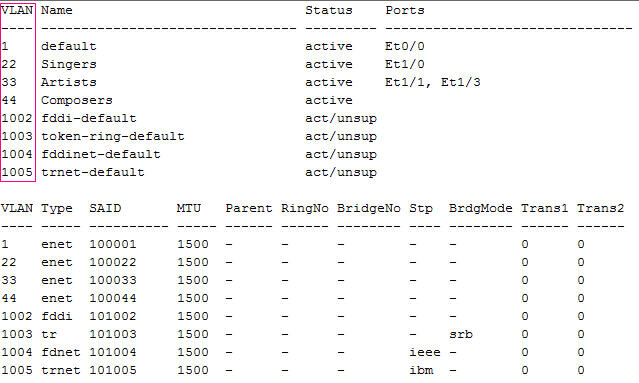
VLAN 1 is the default VLAN on Cisco switch. It always exists and can not be added, modified or removed.
VLANs 1002-1005 are default VLANs for FDDI & Token Ring and they can’t be deleted or used for Ethernet.