Author Archive

Switch Questions

October 14th, 2015

Question 1

If a switch receives a frame with destination MAC not in its MAC address table. What will it proceed this frame?

A. It will drop that frame
B. It will forward that frame out of its trunk ports
C. It will flood that frame out all of its ports except the port that received the frame.
D. It will send an ARP asking for the next-hop


Answer: C

Question 2

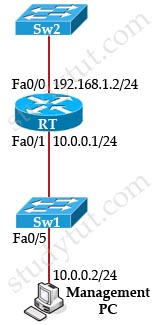
A network administrator wants to manage his new added switchB at a remote office. Which commands should be added to complete this task?
Switch_Remote_Access.jpgA.
Sw2(config)#interface fa0/0
Sw2(config-if)#ip address 192.168.1.1 255.255.255.0
Sw2(config-if)#no shut

B.
Sw2(config)#interface vlan 1
Sw2(config-if)#ip address 192.168.1.1 255.255.255.0
Sw2(config-if)#no shut
Sw2(config-if)#exit
Sw2(config)#ip default-gateway 192.168.1.254

C.
Sw2(config)#interface vlan 1
Sw2(config-if)#ip address 192.168.1.1 255.255.255.0
Sw2(config-if)#no shut
Sw2(config-if)#exit
Sw2(config)#ip default-gateway 10.0.0.1

D.
Sw2(config)#interface vlan 1
Sw2(config-if)#ip address 192.168.1.1 255.255.255.0
Sw2(config-if)#no shut
Sw2(config-if)#exit
Sw2(config)#ip default-gateway 10.0.0.2

E.
Sw2(config)#interface fa0/0
Sw2(config-if)#ip address 192.168.1.1 255.255.255.0
Sw2(config-if)#no shut
Sw2(config-if)#exit
Sw2(config)#ip default-gateway 10.0.0.1

Answer: B

Explanation

To remote access to SwitchB, it must have a management IP address on a VLAN on that switch. Traditionally, we often use VLAN 1 as the management VLAN (but in fact it is not secure).

In the exhibit, we can recognize that the Management Workstation is in a different subnet from the SwitchB. For intersubnetwork communication to occur, you must configure at least one default gateway. This default gateway is used to forward traffic originating from the switch only, not to forward traffic sent by devices connected to the switch.

Question 3

All of the switch ports on a switch were assigned to VLAN 10. What will happen if you assign a switch port to a new VLAN? (Choose two)

A. There will be two collision domains
B. Without a Layer 3 device, devices on the old VLAN cannot communicate with the device on the new VLAN
C. An additional broadcast domain will be created
D. There will be two broadcast domains


Answer: B C

Question 4 <Old question maybe will not shown>

A technician has just connected a router to a switch. What should he do if the two connected ports are not turning green or orange?

A. Check the Ethernet encapsulations on both ports
B. Check the cable between them is a straight-through one
C. Check the router and switch is turned on
D. Check the connectors are not damaged
E. Check if it is an access port


Answer: B C D

Question 5

A hub is connected with 10 hosts. What will happen if this hub is replaced by a switch?

A. The number of broadcast domains are still the same
B. The number of broadcast domains will increase
C. The number of broadcast domains will decrease
D. The number of collision domains are still the same
E. The number of collision domains will increase
F. The number of collision domains will decrease

Answer: A E

Question 6

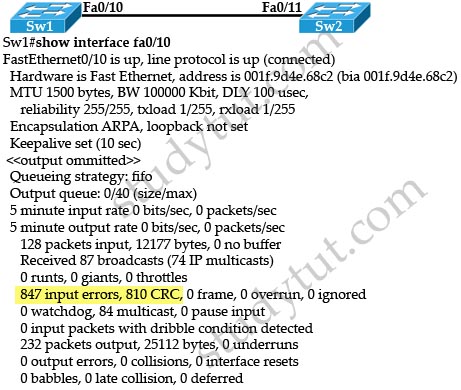
After checking the “show interface” command on Sw1, the administrator noticed the input errors are increasing rapidly. What action should be performed next?
Switch_Show_Interface.jpg
A. The trunk encapsulation mode should be checked
B. The duplex mode should be checked
C. The cable type between two switches should be checked
D. The cable connectors should be checked

Answer: B

Question 7 <Chua giai quyet duoc>

Which of the following statements are correct about Layer 2 switch?

Question 8

Why don’t a switch learn a broadcast address?

A. There are many types of broadcast address that the switch cannot understand
B. The broadcast address makes the MAC address table of the switch operates incorrectly
C. A broadcast address is never the source MAC address
D. Switch does not accept a broadcast message and will drop it


Answer: C

Question 9<chua lam; Rut gon bang MAC con` Fa0/1 & Fa0/5. Explanation sai, Fa0/1 co’ trong cdp neighbors -> trunk; Fa0/5 ko co’ nhung hoc dc 2 tbi -> hub>

Check the outputs below carefully.
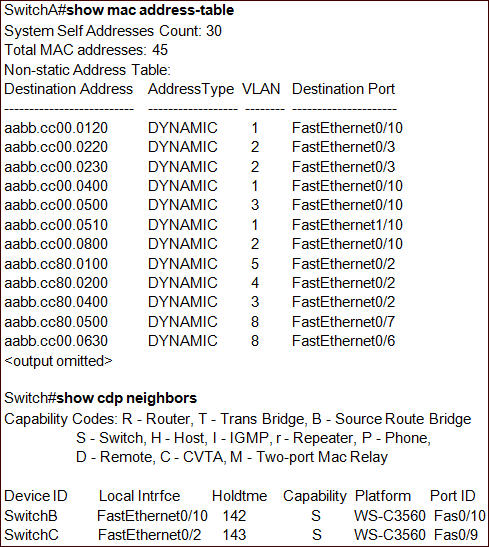
show_mac-address-table_show_cdp_neighbors.jpg

Which of the following statements are correct about SwitchA? (Choose two)

A. The FastEthernet0/6 interface is shutdown
B. The FastEthernet0/10 is connecting to some devices
C. The FastEthernet0/10 is configured as a trunk
D. The FastEthernet0/10 is connecting to a host
E. The FastEthernet0/7 is configured with static MAC address
F. The FastEthernte0/3 is connecting directly to a hub


Answer: C F

Question 10

<Redraw but add the output of ping hostA to switch -> success whist host B ping to switch -> not success>

PC3 can ping the Switch successfully but PC4 cannot. PC4 can ping PC3 and PC5 successfully. What should we do to solve this problem?
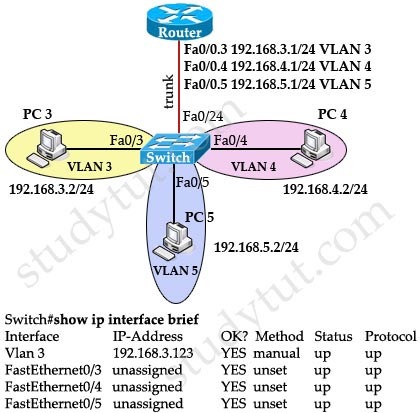
inter_routing.jpgA. We need to configure switch in the same subnet with PC4
B. We need to configure a default gateway on the switch
C. We need to configure “ip routing” command on the switch
D. On the switch, we need to configure “switchport mode trunk” on the interface connecting to the router

Answer: B
WAN Questions

October 14th, 2015

Question 1

Which subprotocol within Point-to-Point Protocol (PPP) is responsible for negotiating authentication?

A. LCP
B. PAP
C. CHAP
D. MS-CHAP


Answer: A

Question 2

You have to configure a serial connection between a Cisco router and a non-Cisco router. Which Layer 2 protocol should you use for this connection?

A. Frame-Relay
B. PPP
C. CHAP
D. IETF

Answer: B

Question 3

Besides PPP, which is a WAN connectivity method?

A. CHAP
B. PAP
C. LAN
D. DSL

Answer: D

Question 4

What are the characteristics of PPP?

A. PPP only supports synchronous circuits
B. PPP only supports asynchronous circuits
C. PPP supports both synchronous and asynchronous circuits
D. PPP supports built-in security mechanisms
E. PPP uses DLCI number to specify the remote partner

Answer: C D

Explanation

PPP supports both synchronous (like analog phone lines) and asynchronous circuits (such as ISDN or digital links). With synchronous circuits we need to use clock rate.

Note: Serial links can be synchronous or asynchronous. Asynchronous connections used to be only available on low-speed (<2MB) serial interfaces, but now, there are the new HWICs (High-Speed WAN Interface Cards) which also support asynchronous mode. To learn more about them please visit http://www.cisco.com/en/US/prod/collateral/modules/ps5949/ps6182/prod_qas0900aecd80274424.html.

Question 5

A network administrator has just issued the “ppp authentication chap pap” command on the serial interface of his router. What is the purpose of this command?

A. This command enables authentication of both CHAP and PAP
B. The other end can choose to authenticate via CHAP or PAP
C. This command enables CHAP authentication and uses PAP as the fallback method
D. This command tells the router to use PAP before trying to use CHAP

Answer: C

Explanation

The command “ppp authentication chap pap” command indicates the CHAP authentication is used first. If it fails or is rejected by other side then uses PAP instead. If you want to use PAP first (then CHAP) you can use the “ppp authentication pap chap” command.

Question 6a

What is the role of a CSU/DSU?

A. It terminates a digital local loop
B. It terminates an analog local loop
C. It is usually a DTE device
D. It is usually a DCE device

Answer: A

Explanation

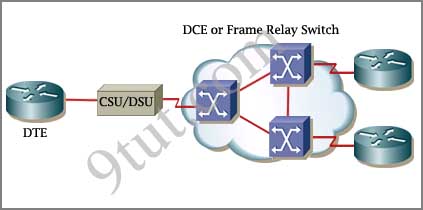
The idea behind a WAN is to be able to connect two DTE networks together through a DCE network. The network’s DCE device (includes CSU/DSU) provides clocking to the DTE-connected interface (the router’s serial interface).

wan_dlci_understand

Question 6b

What is the role of a modem?

A. It terminates a digital local loop
B. It terminates an analog local loop
C. It is usually a DTE device
D. It is usually a DCE device

Answer: B

Question 6c

What is the role of a router in a WAN network?

A. It terminates a digital local loop
B. It terminates an analog local loop
C. It is usually a DTE device
D. It is usually a DCE device
E. It is usually a DTE device
F. It is usually a DCE device

Answer: E

Question 7

Which of the following statements describe CHAP authentication mechanism?

A. It uses one-way handshake
B. It uses two-way handshake
C. It uses three-way handshake
D. CHAP passwords are sent in clear text
E. The authentication process is only required at the beginning of link establishment
F. The authentication process is required periodically after link establishment

Answer: C F

IOS Questions

October 13th, 2015

Question 1

Your colleague asks you to encrypt all the passwords in his router and switch. What command will you use to complete this task?

A. Use the “service password-encryption” under privileged mode
B. Use the “service encryption” command under global configuration mode
C. Use the “service pasword-encryption” command under global configuration mode
D. Use the “no plain-text password” command under global configuration mode
E. Use the “no plain-text password” command under privileged mode.

Answer: C

Question 2

How can you protect your virtual terminal interfaces from remote threats?

A. Create an access list and apply it to the virtual terminal interfaces with the “access-group” command
B. Configure a warning message when someone access to the virtual terminal interfaces
C. Shut down that interface
D. Create a password for the virtual terminal interfaces
E. Create an access list and apply it to the virtual terminal interfaces with the “access-class” command

Answer: D E

Explanation

It is a waste to administratively shut down the interface. Moreover, someone can still access the virtual terminal interfaces via other interfaces -> C is not correct.

To apply an access list to a virtual terminal interface we must use the “access-class” command. The “access-group” command is only used to apply an access list to a physical interface -> A is not correct; E is correct.

The most simple way to secure the virtual terminal interface is to configure a username & password to prevent unauthorized login -> D is correct.

Question 3

<cannot re-create this question>

Question 4

What does the “service password encryption” command do? (Choose two)

A. It encrypts all packets sent through this device
B. It encrypts all passwords in plain text in the configuration file
C. It prompts users enter the pasword when logging in
D. It encrypts all the routing updates sent from this device
E. All current and future passwords will be encrypted

Answer: B E

Explanation

By using this command, all the (current and future) passwords are encrypted. This command is primarily useful for keeping unauthorized individuals from viewing your password in your configuration file.

Question 5 (+ Question 11)

Which of the following statement describe a global command?

A. A command entered in any mode
B. A command that can be used in all versions
C. A command that is commonly used among vendors
E. A command which affects entire router

Answer: E

Explanation

A global command is a command in this form:

Device(config)#

This mode can affect the entire router/switch.

For more information about modes in Cisco devices, please read my Cisco Command Line Interface CLI tutorial.

Question 6

The output below is taken from a router

line vty 0 15
 password 7 424545345435235
 login
 transport input ssh

With this configuration, which of the following statements is correct?

A. Both telnet and SSH connections are allowed to the virtual terminal interfaces
B. Users must enter “424545345435235” to login to virtual terminal interfaces
C. Block the virtual terminal interfaces after seven failed login attempts
D. SSH protocol must be used for incoming traffic to the virtual terminal interfaces

Answer: D

Question 7

Your LAN connectivity is having problems. As a network administrator, which commands should you use to troubleshoot the problems on your router? (Choose three)

A. ping
B. netstat
C. ipconfig
D. ipcfg
E. show ip route
F. show interfaces

Answer: A E F

Explanation

The ping command can be used to test if the local device can reach a specific destination -> A is correct.

“tracert” is not a valid command in Cisco IOS commands, the correct command should be “traceroute” -> B is not correct.

The ipconfig command is not a valid command in Cisco IOS too -> C is not correct.

The “show ip route” command can be used to view the routing table of the router. It is a very useful command to find out many connectivity problems (like directly connected networks, learned network via routing protocols…) -> D is correct.

“winipcfg” is an old tool in Windows 95/98 to view IP settings of the installed network interfaces. But it is not a valid command in Cisco IOS commands -> E is not correct.

The “show interfaces” command is used to check all the interfaces on the local device only. It has very limited information to trouble LAN connectivity problem but it is the most reasonable to choose -> F is acceptable.

Question 8

What commands can be used to check active Telnet connections to your device?

A. show users
B. show sessions
C. show process
D. show cdp neighbors
E. show login

Answer: B


Question 9

Which global command that helps you view directly connected devices?

A. cdp on
B. cdp global
C. cdp run
D. cdp detail

Answer: C

Question 10

Which command will allow only one Telnet connection to the device?
A.
line vty 0 4
login
password tut
B.
line vty 0
login
password tut
C.
line vty 0 4
password single-telnet
D.
line vty 0 4
login
password single-telnet

Answer: B

Explanation

By using the “service password-encryption” command, all the (current and future) passwords are encrypted.

OSI & TCP/IP Model

October 13th, 2015

Question 1

Based on the TCP/IP model, at what layer does routing take place?

A. Application Layer
B. Transport Layer
C. Network Layer
D. Internet Layer  


Answer: D

Explanation

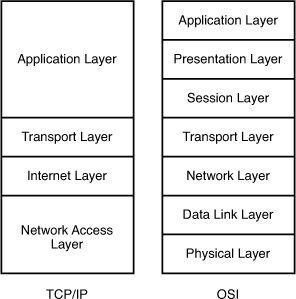
The picture below shows the comparison between TCP/IP model & OSI model. Notice that the Internet Layer of TCP/IP is equivalent to the Network Layer which is responsible for routing decision. OSI_TCP_IP_Comparison.jpgQuestion 2

Refer to exhibit.

Router#show running-config
!
interface FastEthernet0/1
 ip address 192.168.2.10 255.255.255.0
 ip access-group 200 in
!
access-list 200 deny tcp any any eq 22
access-list 200 permit ip any any
!
line con 0
 logging synchronous
 login
line vty 0 4
 login
line vty 5 14
 login
!
end

Why a user cannot Telnet to this router?

A. That user is not in the same network with this router
B. Access list 101 blocked Telnet
C. VTY lines have not been configured with a password
D. The “line con 0” must be configured with “login” command
E. VTY lines must be configured with “transport input telnet” command  


Answer: C

Question 3

What should be checked before installing a new IOS image and which command should be used to check?

A. the remaining of ROM
B. the remaining of flash and RAM memory
C. the remaining of NVRAM
D. show version
E. show running-config  


Answer: B D

Explanation

When upgrading new version of the IOS we need to copy the IOS to the Flash so first we have to check if the Flash has enough memory or not. Also running the new IOS may require more RAM than the older one so we should check the available RAM too. We can check both with the “show version” command.

Question 4

A user tries to ping to 192.168.100.1 and see the output below. At which OSI did layer the problem occur?

C:\> ping 192.168.100.1
Pinging 192.168.100.1 with 32 bytes of data:
Request timed out.
Request timed out.
Request timed out.
Request timed out.
Packets: sent – 4, Received = 0, Lost – 4 (100% loss)

A. Application Layer
B. Presentation Layer
C. Session Layer
D. Data Link Layer
E. Network Layer
F. Physical Layer  


Answer: E

Explanation

The Network layer is responsible for network addressing and routing through the internetwork. So a ping fails, you may have an issue with the Network layer (although lower layers like Data Link & Physical may cause the problem).

Question 5

Point-to-Point Protocol (PPP) provides a standard method for transporting multi-protocol datagrams over point-to-point links. At which OSI layer does the protocol operate?

A. Data Link Layer
B. Physical Layer
C. Transport Layer
D. Session Layer
E. Application Layer  


Answer: A

Question 6

Choose the correct statements about the OSI encapsulation process. (Choose two)

A. Transport layer devides data into smaller segments. Transport layer may also add flow control and reliability information.
B. Data link Layer adds source and destination MAC address and the frame check sequence (FCS) to the segment C. Network layer encapsulates a frame with source and destination IP addresses to create packets
D. Network layer encapsulates a segment with source and destination IP addresses to create packets
E. Physical layer converts a packet into bits 0 and 1  


Answer: A D

Explanation

The Transport Layer segments data into smaller pieces for transport. Each segment is assigned a sequence number, so that the receiving device can reassemble the data on arrival. The Transport Layer also uses flow control to maximize the transfer rate while minimizing the requirements to retransmit. For example, in TCP, basic flow control is implemented by acknowledgment by the receiver of the receipt of data; the sender waits for this acknowledgment before sending the next part. -> A is correct.

The Data Link Layer adds physical source and destination addresses and an Frame Check Sequence (FCS) to the packet (on Layer 3), not segment (on Layer 4) -> B is not correct.

Packets are created when network layer encapsulates a segment (not frame) with source and destination host addresses and protocol-related control information. Notice that the network layer encapsulates messages received from higher layers by placing them into datagrams (also called packets) with a network layer header -> C is not correct.

The Network Layer (Layer 3) has two key responsibilities. First, this layer controls the logical addressing of devices. Second, the network layer determines the best path to a particular destination network, and routes the data appropriately. -> D is correct.

The Physical Layer (not Presentation Layer) translates bits into voltages for transmission across the physical link -> E is not correct.

Question 7

What is the highest OSI layer that an FTP connection is used to connect to a server?

A. Application Layer
B. Session Layer
C. Presentation Layer
D. Transport Layer
E. Network Layer
F. Data Link Layer  


Answer: A

Explanation

FTP belongs to Application layer and it is also the highest layer of the OSI model.

Question 8

A colleague asks you at which layer the Rapid Spanning-tree Protocol (RSTP) operates. You will answer:

A. Application Layer
B. Transport Layer
C. Network Layer
D. Data Link Layer
E. Physical Layer  


Answer: D

Question 9

Which OSI layer is responsible for determining the identity and availability of communication partners for an application with data to transmit?

A. Application Layer
B. Session Layer
C. Presentation Layer
D. Transport Layer
E. Network Layer
F. Data Link Layer  


Answer: A

Question 10

At which OSI layer does a frame checksum is performed ?

A. Transport Layer
B. Session Layer
C. Presentation Layer
D. Data Link Layer
E. Network Layer
F. Application Layer  


Answer: D

Explanation

When using the term “frame” we can easily recognize it belongs to the Data Link layer. In this layer, an Frame Check Sequence (FCS) field is added to the frame to verify that the frame data is received correctly.

Basic Questions

September 4th, 2015

Question 1

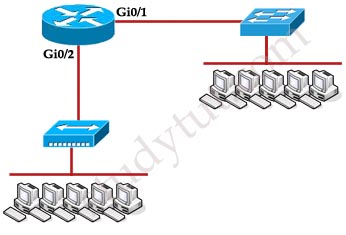
How many broadcast domains and collision domains in the network shown below?

Collision_Domain_Broadcast_Domain.jpgA. Two broadcast domains
B. Three broadcast domains
C. Four broadcast domains
D. Two collision domains
E. Seven collision domains
F. Nine collision domains


Answer: A E

Question 2

Refer to the output:

System flash director
……
[2658271 bytes used,10947492 available, 13605763 total] 4096K bytes of processor board System flash(Read/Write)

Suppose you want to upload a new IOS to the router but still want to keep the existing IOS on it. What is the maximum size (in MB) of the new IOS file so that both can be kept in the router?

A. 1 MB
B. 4 MB
C. 10 MB
D. 12 MB


Answer: C

Explanation

From the exhibit we learn there are 10947492 bytes (over 10MB) available so it is only enough space for an IOS file of 10MB. If bigger file is copied then the existing IOS file will be erased (overwritten).

Question 3

Checking the output of the “show interfaces E0/0” below. What does the line “MTU 1500 bytes” mean?

Router#show interfaces ethernet1/0
Ethernet1/0 is up, line protocol is up
Hardware is AmdP2, address is aabb.cc00.0100 (bia aabb.cc00.0100)
Internet address is 10.1.1.17/30
MTU 1500 bytes, BW 10000 Kbit/sec, DLY 1000 usec,
reliability 255/255, txload 1/255, rxload 1/255

A. 1500 is the maximum number of bytes per second are allowed to pass through this this interface.
B. 1500 is the minimum number of bytes per second are allowed to pass through this interface.
C. 1500 is the maximum segment size are allowed to pass through this interface.
D. 1500 is the maximum frame size are allowed to pass through this interface.
E. 1500 is the maximum packet size that is allowed to pass through this interface.


Answer: E

Question 4

You have just detected a device whose interface ports have collision detection and carrier sensing enabled on the shared twisted pair environment. What conclusion can be deduced from this interface?

A. It is a Serial interface
B. It is a 100Mbps interface
C. It is an Ethernet interface which operates at half duplex
D. It is an Ethernet interface which operates at full duplex
E. This interface is faulty


Answer: C

Explanation

Modern Ethernet networks built with switches and full-duplex connections no longer utilize CSMA/CD. CSMA/CD is only used in obsolete shared media Ethernet (which uses repeater or hub).

Question 5

What conditions must be met so that a device can transmit in the Ethernet medium? (Choose two)

A. When it is granted to do so
B. When it detects a carrier
C. When it detects no other devices are transmitting
D. When the medium is idle
E. When it has a token
F. When other devices inform it can transmit


Answer: C D

Explanation

Ethernet network is a shared environment so all devices have the right to access to the medium. If more than one device transmits simultaneously, the signals collide and can not reach the destination.

If a device detects another device is sending, it will wait for a specified amount of time before attempting to transmit.

When there is no traffic detected, a device will transmit its message. While this transmission is occurring, the device continues to listen for traffic or collisions on the LAN. After the message is sent, the device returns to its default listening mode.

So we can see C and D are the correct answers. But in fact “answer C – when they detect no other devices are sending” and “when the medium is idle” are nearly the same.

Question 6

Why does Ethernet protocol use physical addresses? (Choose two)

A. To identify devices at Layer 2
B. To allow two devices on different network to communicate
C. To identify devices at Layer 1
D. To quickly short the priority of each device
E. To allow two devices to communicate if they are on the same network


Answer: A E

Explanation

Physical addresses (MAC addresses) are used to identify devices at layer 2 -> A is correct.

MAC addresses are only used to communicate on the same network. To communicate on different network we have to use Layer 3 addresses (IP addresses) -> B is not correct; E is correct.

Layer 2 frame and Layer 3 packet can be recognized via headers. Layer 3 packet also contains physical address -> C is not correct.

On Ethernet, each frame has the same priority to transmit by default -> D is not correct.

All devices need a physical address to identify itself. If not, they can not communicate -> F is not correct.

Question 7

The “boot system” command used to tell the devices where to look for the IOS image. Where can this command point to?

A. NVRAM
B. RAM
C. Flash Memory
D. SNMP Server
E. TFTP Server


Answer: C E

Explanation

The following locations can be configured as a source for the IOS image with the “boot system” command:
+ Flash (the default location)
+ TFTP server
+ ROM (used if no other source is found)

Question 8

What are a CSU/DSU and a modem used for? (Choose two)

A. A CSU/DSU transforms digital signal to a leased line
B. A CSU/DSU transforms analog signal to a leased line
C. A modem transforms analog signal to a phone line
D. A modem transforms digital signal to a phone line


Answer: A D

Question 9

After the POST process is completed, the router is going to locate an IOS image. What will it perform next?

A. Check the configuration register
B. Boot from the location of “boot system” command
C. Check the NVRAM
D. Check its standard disk


Answer: A

Explanation

When you turn the router on, it runs through the following boot process.

The Power-On Self Test (POST) checks the router’s hardware. When the POST completes successfully, the System OK LED indicator comes on.
The router checks the configuration register to identify where to load the IOS image from. A setting of 0×2102 means that the router will use information in the startup-config file to locate the IOS image. If the startup-config file is missing or does not specify a location, it will check the following locations for the IOS image:

1. Flash (the default location)
2. TFTP server
3. ROM (used if no other source is found)

The router loads the configuration file into RAM (which configures the router). The router can load a configuration file from:

+ NVRAM (startup-configuration file)
+ TFTP server
If a configuration file is not found, the router starts in setup mode.

IPv6 Questions

September 4th, 2015

Note: These questions are for practicing purpose only.

Question 1

An example of an IPv6 address is 2001:0:110F::9DC:876A:120A. What is the first 24 bits of an IPv6 address called?

A. BIA
B. MAC
C. OUI
D. MAC-header
E. NIC

Answer: C

Question

How many bits does an IPv6 address have?

A. 48
B. 64
C. 128
D. 256
E. 512

Answer: C

CCNA Introduction

August 24th, 2015

a