CCNA Category

Access List Questions

November 4th, 2015

Question 1

Which one of the following statement is a standard access-list?

A. access-list 30 permit 10.2.0.0 0.0.255.255
B. access-list 100 permit ip 10.0.0.0 any
C. access-list 2710 deny udp host 172.16.1.1 any eq 50
D. access-list 101 deny tcp any any


Answer: A

Explanation

The standard access lists are ranged from 1 to 99 and from 1300 to 1999 so only access list 50 is a standard access list.

Question 2

Which two standard access-lists will allow traffic from networks 192.168.12.0, 192.168.13.0, 192.168.14.0 and 192.168.15.0? (Choose two)

A. access-list 45 192.168.12.0 0.0.1.255
B. access-list 45 192.168.14.0 0.0.1.255
C. access-list 45 192.168.12.0 0.0.0.255
D. access-list 45 192.168.13.0 0.0.0.255
E. access-list 45 192.168.14.0 0.0.3.255


Answer: A B

Question 3

Check the output below

TUT_Router#show run
<output omitted>
access-list 200 permit ip 172.16.0.0 0.0.255.255 any eq www
access-list 200 deny ip any any

TUT_Router#show ip interface fa0/1
FastEthernet0/1 is up, line protocol is up
Internet address is 10.10.10.1/20
Broadcast address is 255.255.255.255
Outgoing access list is 200
Inbound access list is not set

Which command will remove access-list 200 from interface Fa0/1?

A. TUT_Router(config-if)#no ip access-class 200 in
B. TUT_Router(config-if)#no ip access-class 200 out
C. TUT_Router(config-if)#no ip access-list 200 in
D. TUT_Router(config-if)#no ip access-list 200 out
E. TUT_Router(config-if)#no ip access-group 200 in
F. TUT_Router(config-if)#no ip access-group 200 out


Answer: F

Question 4

What parameters a standard access list uses to filter traffic? (Choose two)

A. source address
B. destination address
C. subnet mask
D. wildcard mask


Answer: A D

Question 5

You are working for the TECHTUT company. You are requested to block subnet 198.9.200.128/28 from accessing the resource, except the first and last IP. But the access-list must not prevent anyone else from using the resource. Given the following statements, please arrange them in the correct order:

1. permit 198.9.200.129
2. permit any
3. permit 198.9.200.142
4. deny 198.9.200.128 0.0.0.15

A. 2,3,1,4
B. 1,3,4,2
C. 1,2,3,4
D. 4,2,3,1
E. 4,1,2,3


Answer: B

Question 6

What of the following statements about using access list is true?

A. Only one access list per direction, per layer 3 protocol can be configured
B. More than one access list per direction, per layer 3 protocol can be configured
C. one access list per direction, per layer 2 protocol can be configured
D. More than one access list per direction, per layer 2 protocol can be configured


Answer: A

Explanation

We can have only 1 access list per protocol, per direction and per interface. It means:

+ We can not have 2 inbound access lists on an interface
+ We can have 1 inbound and 1 outbound access list on an interface

Question 7

What type of access list can be used to temporarily allow a user with a pre-defined username and password to access the network?

A. standard access-list
B. extended access-list
C. reflexive access-list
D. dynamic access-list


Answer: D

Explanation

We can use a dynamic access list to authenticate a remote user with a specific username and password. The authentication process is done by the router or a central access server such as a TACACS+ or RADIUS server. The configuration of dynamic ACL can be read here: http://www.cisco.com/en/US/tech/tk583/tk822/technologies_tech_note09186a0080094524.shtml

RSTP Questions

October 28th, 2015

Question 1

What facts about RSTP are true? (Choose three)

A. The topology recovers significantly faster when a link fails
B. There are two additional port soles comparing to STP, which are backup and alternative roles
C. There are four port roles in RSTP which blocking, discarding, learning and forwarding
D. The recovery time of RSTP is nearly the same as STP
E. RSTP transitions to forwarding state faster than STP on point to point links


Answer: A B E

Question 2

Check the output below:
show_spanning_tree_vlan_1.jpg

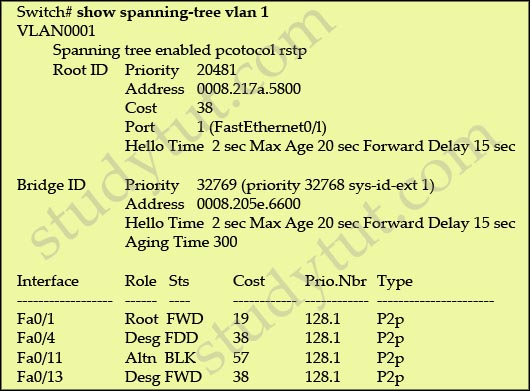
What conclusion can be made from this output?

A. There are more than one port that connect to the root bridge
B. The root bridge is running normal spanning-tree protocol
C. The MAC address of the root bridge is lower than that of the local switch
D. The bridge ID of the root bridge is higher than that of the local switch


Answer: D

Explanation

As we can see from the output above, the priority of the root bridge is 20481 while that of the local bridge is 32769.

Question 3

What is the suitable command to enable RSTP?

A. Switch(config)#spanning-tree mode rapid-pvst
B. Switch(config)#spanning-tree mode pvst
C. Switch(config)#spanning-tree mode rstp
D. Switch(config)#spanning-tree guard loop
E. Switch(config)#spanning-tree mode rapid-stp


Answer: A

Question 4

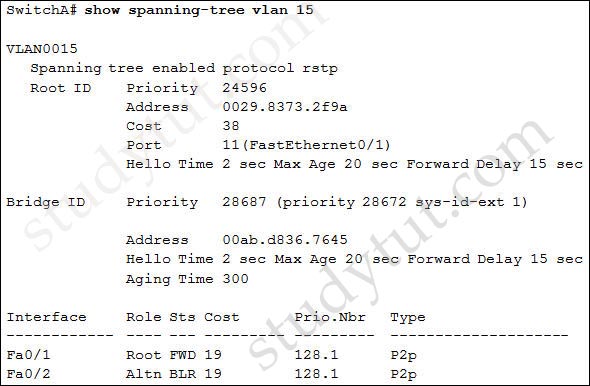
Check the output below. Which of the following statements is correct?
show_spanning_tree_vlan.jpg

<Redraw;Fa0/11,12 -> Fa0/1,2;SwitchA -> Switch;VLAN20->VLAN15;change root MAC>

A. From the role of Fa0/1 we can conclude this is the root bridge
B. VLAN 15 is running pvst
C. The root bridge MAC address is 00ab.d836.7645
D. From the port roles we can conclude this is not the root bridge


Answer: D

Explanation

Only non-root bridge can have root port. Fa0/1 is the root port so we can confirm this switch is not the root bridge -> A is not correct.

From the output we learn this switch is running Rapid STP, not PVST -> B is not correct.

00ab.d836.7645 is the MAC address of this switch, not of the root bridge. The MAC address of the root bridge is 0029.8373.2f9a -> C is not correct.

All of the interface roles of the root bridge are designated. SwitchA has one Root port and 1 Alternative port so it is not the root bridge -> D is correct.

Question 5

Check the output below. Which of the following statements are correct? (Choose three)
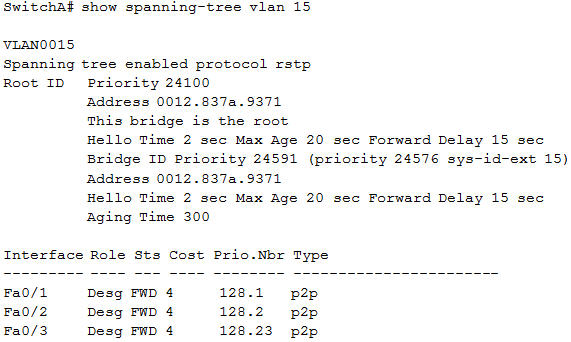
show_spanning_tree_vlan_15.jpg

A. All ports are in the state of discarding, forwarding or learning
B. There are 300 VLANs on this switch
C. The root priority of this switch is lower than the default priority
D. All three interfaces on this switch are in shared media
E. Ports in designated role are forwarding traffic
F. Besides VLAN 15, this switch is also the root bridge for other VLANs


Answer: A C E

Explanation

From the output, we see that all ports are in Designated role (forwarding state) -> A and E are correct.

The command “show spanning-tree vlan 15″ only shows us information about VLAN 15. We don’t know how many VLAN exists in this switch -> B is not correct.

The bridge priority of this switch is 24100 which is lower than the default value bridge priority 32768 -> C is correct.

All three interfaces on this switch have the connection type “p2p”, which means Point-to-point environment – not a shared media -> D is not correct.

The only thing we can specify is this switch is the root bridge for VLAN 15 but we can not guarantee it is also the root bridge for other VLANs -> F is not

Question 6

What are the port states of RSTP when it has converged? (Choose two)

A. learning
B. listening
C. disabled
D. forwarding
E. discarding


Answer: D E

Explanation

RSTP only has 3 port states that are discarding, learning and forwarding. When RSTP has converged there are only 2 port states left: discarding and forwarding.

Question 7

Which of the following statements are correct about RSTP? (Choose two)

A. RSTP is compatible with the old 802.1D protocol
B. RSTP is not compatible with PVST+
C. RSTP is a proprietary protocol
D. RSTP introduces new port roles
E. RSTP introduces no new port roles


Answer: A D

Question 8

Refer to the topology below. All four switches in the topology are running RSTP with default settings. Which of the following statements describing port roles of the ports are correct?
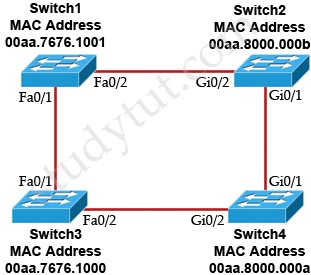
RSPT_port_roles.jpg

A. Switch1,Fa0/2 with designated role
B. Switch1, Fa0/1 with root role
C. Switch2, Gi0/1 with root role
D. Switch2, Gi0/1 with designated role
E. Switch3, Fa0/2 with root role
F. Switch4, Gi0/2 with root role


Answer: A B F

Explanation

The question says “with default settings” so we can understand these switches have the same bridge priority. Switch3 has lowest MAC address so it will become root bridge and 2 of its ports (Fa0/1 & Fa0/2) will be designated ports -> E is incorrect.

Because Switch3 is the root bridge so the 2 ports nearest Switch3 on Switch1 (Fa0/1) and Switch4 (Gi0/2) will be root ports -> B and F are correct.

Now we come to the most difficult part of this question: Switch2 must have a root port so which port will it choose? To answer this question we need to know about STP cost and port cost.

In general, “cost” is calculated based on bandwidth of the link. The higher the bandwidth on a link, the lower the value of its cost. Below are the cost values you should memorize:

Link speed Cost
10Mbps 100
100Mbps 19
1 Gbps 4

Switch2 will choose the interface with lower cost to the root bridge as the root port so we must calculate the cost on interface Gi0/1 & Gi0/2 of Switch2 to the root bridge. This can be calculated from the “cost to the root bridge” of each switch because a switch always advertises its cost to the root bridge in its BPDU. The receiving switch will add its local port cost value to the cost in the BPDU.

In the exhibit you also we FastEthernet port is connecting to GigabitEthernet port. In this case GigabitEthernet port will operate as a FastEthernet port so the link can be considered as FastEthernet to FastEthernet connection.

One more thing to notice is that a root bridge always advertises the cost to the root bridge (itself) with an initial value of 0.

Now let’s have a look at the topology again
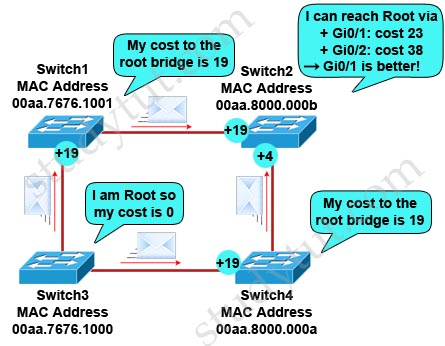
RSPT_port_roles2.jpg

Switch3 advertises its cost to the root bridge with a value of 0. Switch4 adds 19 (the cost value of 100Mbps link although the port on Switch D is GigabitEthernet port) and advertises this value (19) to Switch2. Switch2 adds 4 (the cost value of 1Gbps link) and learns that it can reach Switch3 via Gi0/1 port with a total cost of 23. The same process happens for Switch1 and Switch2 learns that it can reach Switch3 via Gi0/2 with a total cost of 38 -> Switch2 chooses Gi0/1 as its root port -> D is not correct.

Now our last task is to identify the port roles of the ports between Switch1 & Switch2. It is rather easy as the MAC address of Switch1 is lower than that of Switch2 so Fa0/2 of Switch1 will be designated port while Gi0/2 of Switch2 will be alternative port -> A is correct but C is not correct.

Below summaries all the port roles of these switches:
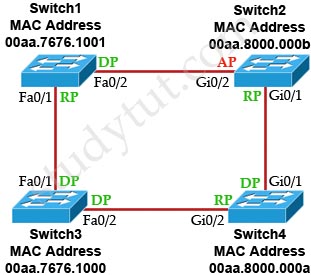
RSPT_port_roles_details.jpg

+ DP: Designated Port (forwarding state)
+ RP: Root Port (forwarding state)
+ AP: Alternative Port (blocking state)

Question 9

Refer to the topology below. After RSTP has been converged, which switch port on which switch in the Access layer will take the discarding role?
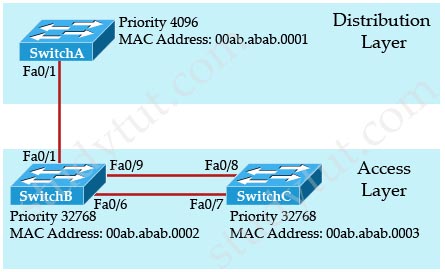
RSTP_election_port_roles.jpg

A. SwitchB, Fa0/6
B. SwitchB, Fa0/9
C. SwitchC, Fa0/7
D. SwitchC, Fa0/8


Answer: D

Explanation

In this question, we only care about the Access Layer switches (SwitchB & C). SwitchB has a lower bridge ID than SwitchC (because the MAC of SwitchB is smaller than that of SwitchC) so both ports of SwitchB will be in forwarding state. The alternative port will surely belong to SwitchC.

SwitchC will need to block one of its ports to avoid a bridging loop between the two switches. But how does SwitchC select its blocked port? Well, the answer is based on the BPDUs it receives from SwitchB. A BPDU is superior than another if it has:

1. A lower Root Bridge ID
2. A lower path cost to the Root
3. A lower Sending Bridge ID
4. A lower Sending Port ID

These four parameters are examined in order. In this specific case, all the BPDUs sent by SwitchC have the same Root Bridge ID, the same path cost to the Root and the same Sending Bridge ID. The only parameter left to select the best one is the Sending Port ID (Port ID = port priority + port index). In this case the port priorities are equal because they use the default value, so SwitchC will compare port index values, which are unique to each port on the switch, and because Fa0/9 is inferior to Fa0/6, SwitchC will select the port connected with Fa0/6 (of SwitchB) as its root port and block the other port -> Port fa0/8 of SwitchC will be blocked (discarding role).

If you are still not sure about this question, please read my RSTP tutorial.
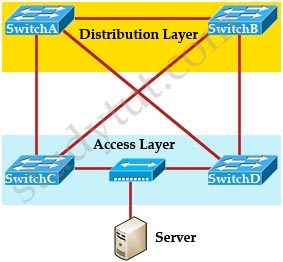
STP Questions 2

October 28th, 2015

Question 1

What should be used to elect a root bridge if all parameters are left at default values?

A. the highest MAC address
B. the lowest MAC address
C. the highest interface number
D. the lowest interface number


Answer: B

Question 2

Your company is connecting some switches. What is the potential problem and the solution for this? (Choose two)

A. routing loop
B. switching loop
C. Spanning-tree Protocol
D. VLAN Trunking Protocol
E. Dynamic Trunking Protocol


Answer: B C

Question 3

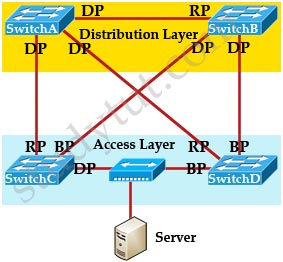
STP_Designated_Ports_Role.jpg

Given the following information:

SwitchA:
+ Priority: 4096
+ MAC: 00aa.bbcc.ddaa
SwitchB:
+ Priority: 12288
+ MAC: 00aa.bbcc.bb
SwitchC:
+ Priority: 32768
+ MAC: 00aa.bbcc.ddee
SwitchD:
+ Priority: 32768
+ MAC: 00aa.bbcc.ddff

Which switch provides designated port role for the network segment that serves the server?

A. SwitchA
B. SwitchB
C. SwitchC
D. SwitchD


Answer: C

First, the question asks what switch services the printers, so it can be SwitchC or SwitchD which is connected directly to the Server.

Next, by comparing the MAC address of SwitchC and SwitchD we found that the MAC of SwitchC is smaller. Therefore the interface connected to the Server of SwitchC will become designated interface and the interface of SwitchD will be blocked. The picture below shows the roles of all ports:

STP_Designated_Ports_Role_Explain.jpg

DP: Designated Port
RP: Root Port
BP: Blocked Port

(Please notice that SwitchA will become the root bridge because of its lowest priority, not SwitchC)

STP Questions

October 26th, 2015

Question 1<Redraw A,B,C->Sw1,2,3;Fa0/0,1 -> Fa0/23-24>

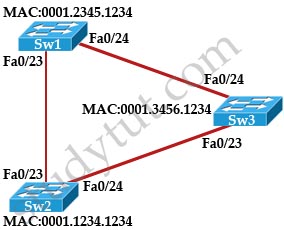
STP_Designated_Ports.jpg

Your company has just added three new switches and they are connected as the topology below. After the STP convergence, which ports will become designated ports, suppose all switches are using default priority?

A. Sw1 – Fa0/23
B. Sw1 – Fa0/24
C. Sw2 – Fa0/23
D. Sw2 – Fa0/24
E. Sw3 – Fa0/23
F. Sw3 – Fa0/24


Answer: B C D

Explanation

First by comparing their MAC addresses we learn that Sw1 will be root bridge as it has lowest MAC. Therefore all of its ports are designated ports -> C & D are correct.

On the link between Sw1 & Sw3 there must have one designated port and one non-designated (blocked) port. We can figure out which port is designated port by comparing their MAC address again. A has lower MAC so Fa0/24 of Sw1 will be designated port while Fa0/24 of Sw3 will be blocked -> B is correct.

Question 2

What parameter is mostly used to specify the root port on non-root bridges?

A. MAC address
B. Revision number
C. Port priority number
D. Path cost


Answer: D

Explanation

The path cost to the root bridge is the most important value to determine which port will become the root port on each non-root switch. In particular, the port with lowest cost to the root bridge will become root port (on non-root switch).

Question 3

Which statements are correct about PVST+?

A. PVST+ helps saving some VLAN instances
B. PVST+ maintains a spanning tree instance for each VLAN
C. PVST+ allows choosing the root bridge location to optimize the traffic of each VLAN
D. PVST+ reduces Layer 3 loops


Answer: B C

Explanation

Per VLAN Spanning Tree (PVST) maintains a spanning tree instance for each VLAN configured in the network. It means a switch can be the root bridge of a VLAN while another switch can be the root bridge of other VLANs in a common topology. For example, Switch 1 can be the root bridge for Voice data while Switch 2 can be the root bridge for Video data. If designed correctly, it can optimize the network traffic.

Question 4

What Layer 2 protocols are used to prevent loops? (Choose two)

A. 802.1Q
B. STP
C. 802.1d
D. 802.3
E. VTP


Answer: B C

Question 5

After investigating your company network, you realize that multiple copies of unicast packets are transmitted in your LAN. What is the most likely problem?

A. There is a broken link somewhere in your LAN
B. During in high traffic time
C. You are having an improperly redundant topology
D. Your network is using star topology
E. Your network is using token ring topology


Answer: C

Explanation

If we connect two switches via 2 or more links and do not enable STP on these switches then a loop (which creates multiple copies of the same unicast frame) will occur. It is an example of an improperly implemented redundant topology.

Question 6

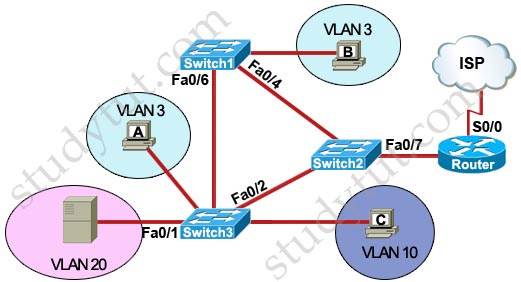
Refer to the topology below:

STP_convergence.jpg

What will be the result of Fa0/6 on Switch1 being disconnected if all switches are using default values?

A. Host B cannot get data from the Server in VLAN 20
B. Host B cannot communicate to other hosts in other VLANs
C. Host B can still communicate to other hosts in other VLANs but the communication is very slow
D. Host B cannot access the server in VLAN 20 in less than one minute. Then the normal connection would resume


Answer: D

Question 7

What is the new port state of Rapid-PVST?

A. blocking
B. learning
C. listening
D. forwarding
E. discarding


Answer: E

Explanation

PVST+ is based on IEEE802.1D Spanning Tree Protocol (STP). But PVST+ has only 3 port states (discarding, learning and forwarding) while STP has 5 port states (blocking, listening, learning, forwarding and disabled). So discarding is a new port state in PVST+.

Question 8

Given the topology below. All parameters are set to default, which switch will become the root bridge?

A. Sw1, because of its lowest MAC
B. Sw1, because of its lowest priority
C. Sw2, because of its lowest MAC
D. Sw2, because of its lowest priority
E. Sw3, because of its lowest MAC
F. Sw3, because of its lowest priority
G. Sw4, because of its lowest priority


Answer: F

Question 9

Your Layer 2 network has all switch ports in either blocking or forwarding states. Which term is often used to describe this state?

A. complete
B. successful
C. converged
D. good
E. full


Answer: C

Explanation

Spanning Tree Protocol convergence (Layer 2 convergence) happens when bridges and switches have transitioned to either the forwarding or blocking state. When layer 2 is converged, root bridge is elected and all port roles (Root, Designated and Non-Designated) in all switches are selected.

Question 10

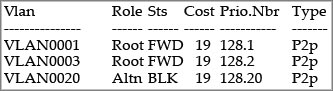
Switch# show spanning-tree interface fastethernet0/5

show_spanning-tree_interface.jpg

From the output below, what is the most likely cause that interface fa0/5 is not the root port on VLAN 20?

A. Another port has lower path cost to the root bridge
B. The priority of this port is higher than another port in VLAN 20
C. This switch can only become root bridge for odd VLAN numbers
D. Interface Fa0/5 is manually set to Alternative state


Answer: A

InterVLAN Questions

October 25th, 2015

Question 1

Check the topology below <Redraw,Router:Fa0/0 -> Change Fa0/1;Sw1,2:Fa0/24->Fa0/1;192.168.1.0 changes to 10.1.1.0/24;VLAN changes to 15,20>

In this topology, interVLAN routing is configured. What two statements are correct? (Choose two)

A. Subinterfaces must be configured on Fa0/1 of Router
B. On Sw2, the default gateway must be set
C. The interfaces connecting between Router and Sw2 must be configured using same encapsulation type
D. Hosts in VLAN 15 and VLAN 20 can communicate with each other without using the Router
E. The main interface Fa0/0 of the Router must be assigned an IP address


Answer: A C

Question 5

Refer to the topology below <Redraw>

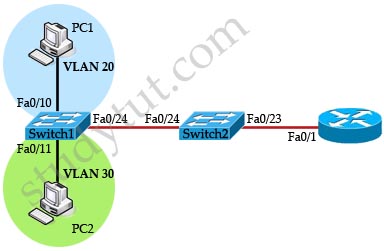
interVLAN_two_switches.jpgThe Router and two 2960 switches have been configured properly. Which command should be used on Fa0/24 on the two switches so that PC1 in VLAN 20 can communicate with PC2 in VLAN 30?
A. No further configuration is required
B. Switch1(config-if)#switchport mode trunk
C. Switch1(config-if)#switchport mode access
D. Switch1(config-if)#switchport encapsulation dot1q

Answer: B

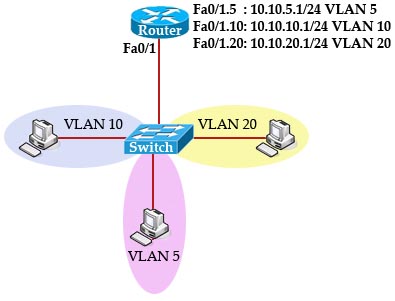
Question 7

Check the following topology.

InterVLAN_Routing.jpg

A switch is configured with some VLANs. All the hosts on this switch have been configured with suitable default gateway. A router is directly connected to the switch and is configured as a “router-on-a-stick”. All subinterfaces are configured correctly and the main interface was turned on. IP routing is also enabled. What commands should be configured on the router?

A.
Router(config)#router ospf 100
Router(config-if)# network 10.10.0.0 0.0.255.255 area 0
B.
Router(config)#router eigrp 100
Router(config-if)# network 10.10.0.0 0.0.255.255
C. The configuration was good. No commands need to be added
D.
Router(config)#ip route 0.0.0.0 0.0.0.0 10.10.5.1


Answer: C

Question 8

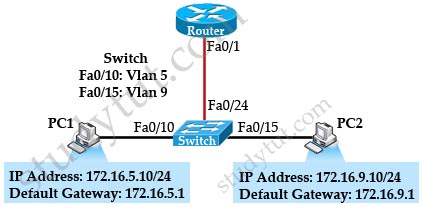
Check the following topology

InterVLAN_Two_PCs.jpgWhat commands should be used on the Switch and Router to allow PC1 and PC2 to communicate? (Choose two)


A.
Router(config)#interface fa0/1
Router(config-if)#ip address 10.0.0.1 255.255.255.0
Router(config-if)#no shutdown

B.
Router(config)#interface fa0/1
Router(config-if)#no shutdown
Router(config-if)#interface fa0/1.5
Router(config-if)#encapsulation dot1q 5
Router(config-if)#ip address 172.16.5.1 255.255.255.0
Router(config-if)#interface fa0/1.9
Router(config-if)#encapsulation dot1q 9
Router(config-if)#ip address 172.16.9.1 255.255.255.0

C.
Router(config)#interface fa0/1
Router(config-if)#no ip address
Router(config-if)#no shutdown

D.
Router(config)#ip route 0.0.0.0 0.0.0.0 172.16.5.1
Router(config)#ip route 0.0.0.0 0.0.0.0 172.16.9.1 2

E.
Router(config)#router ospf 1
Router(config-router)#network 172.16.5.0 0.0.0.255 area 0
Router(config-router)#network 172.16.9.0 0.0.0.255 area 0

F.
Switch(config)#interface fa0/24
Switch(config-if)#switchport mode trunk

G.
Switch(config)#interface fa0/24
Switch(config)#switchport mode access


Answer: B F

Question 9

Your company has five different VLANs and they need to communicate with each other but your router only has two interfaces left. How will you complete this task using the fewest physical interfaces on the router?

A. Add three more interfaces
B. Add another router to handle other VLANs
C. Add a switch and connect all five VLANs to this switch, then connect an interface on this switch to an interface on the router
D. Use the router-on-a-stick configuration

Answer: D

EtherChannel

October 25th, 2015

Question 1

Refer to the topology below

EtherChannel_Two_Switches.jpg

A technician is trying to configure EtherChannel on two switches. The following command have been configured on Switch1:

interface range Fa0/23 – 24
 switchport trunk encapsulation dot1q
 switchport mode trunk
 channel-group 1 mode auto

What commands should be issued on Switch2 so that it can form an EtherChannel link with Switch1?

A.
interface range fa0/23 – 24
switchport trunk encapsulation dot1q
switchport mode trunk
channel-group 1 mode active

B.
interface range fa0/23 – 24
switchport trunk encapsulation dot1q
switchport mode trunk
channel-group 1 mode auto

C.
interface range fa0/23 – 24
switchport trunk encapsulation dot1q
switchport mode trunk
channel-group 1 mode desirable

D.
interface range fa0/23 – 24
switchport trunk encapsulation dot1q
switchport mode trunk
channel-group 1 mode passive


Answer: C

Explanation

From the configuration of Switch1, we see it is using Port Aggregation Protocol (PAgP) with “auto” mode so the other end (Switch2) must also runs PAgP with “desirable” mode to actively sending request to form an Etherchannel.

Question 2

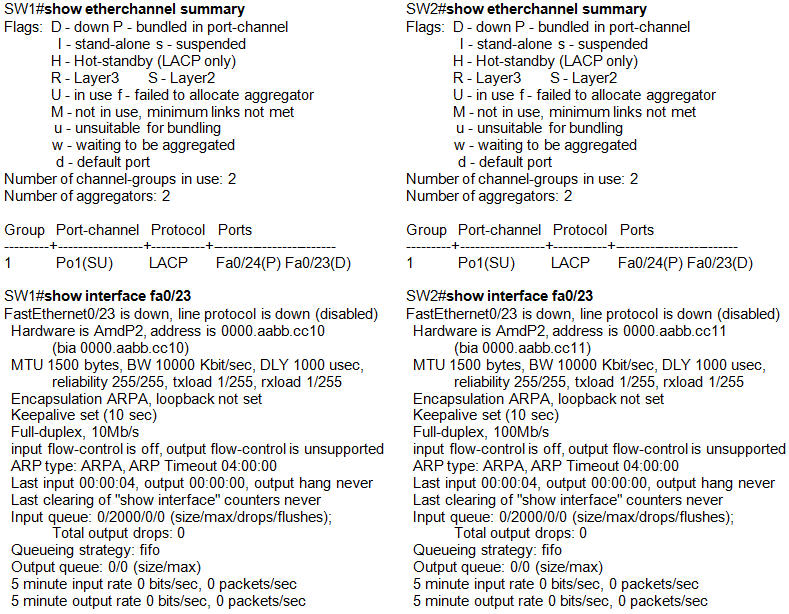
A technician is trying to configure EtherChannel on two switches via Fa0/23 and Fa0/24 but the EtherChannel is not formed. The output of the “show interface fa0/23” commands are shown below. What is the problem?

EtherChannel_Two_Switches.jpg

show_etherchannel_summary_show_interface.jpg

A. Both Fa0/23 interfaces are turned off
B. Their MAC addresses are mismatched
C. Their speeds are mismatched
D. Their encapsulations are mismatched


Answer: C

Explanation

All interfaces in an EtherChannel must be configured identically to form an EtherChannel. Specific settings that must be identical include:
+ Speed settings
+ Duplex settings
+ STP settings
+ VLAN membership (for access ports)
+ Native VLAN (for trunk ports)
+ Allowed VLANs (for trunk ports)
+ Trunking Encapsulation (ISL or 802.1Q, for trunk ports)

In the output of the “show interface fa0/23” commands we see the speed of interface Fa0/23 of SW1 is “100Mb/s” while that of SW2 is “10Mb/s” so the speed is mismatched here -> an Etherchannel will not be formed.

Question 3

A technician is configuring a Layer 3 EtherChannel by grouping two interfaces into channel group 10. Now he needs to assign an IP address for this EtherChannel. Which interface should he assign the IP address?

A. The port-channel 10 interface
B. Any member interface
C. The highest port number in the member interfaces
D. The lowest port number in the member interfaces


Answer: A

Explanation

When an EtherChannel is created, a logical interface will be created on the switches or routers representing for that EtherChannel. You can configure this logical interface in the way you want. For example, assign access/trunk mode on switches or assign IP address for the logical interface on routers… An example of a Layer 3 Etherchannel port is shown below:

interface PortChannel1
description Link to R2
ip address 10.2.4.13 255.255.255.252

Question 4

A technician is configuring EtherChannel port. What parameter can be set differently on member ports?

A. Speed settings
B. Duplex settings
C. Native VLAN
D. Allowed VLANs
E. DTP settings of negotiation


Answer: E

Explanation

All interfaces in an EtherChannel must be configured identically to form an EtherChannel. Specific settings that must be identical include:
+ Speed settings
+ Duplex settings
+ STP settings
+ VLAN membership (for access ports)
+ Native VLAN (for trunk ports)
+ Allowed VLANs (for trunk ports)
+ Trunking Encapsulation (ISL or 802.1Q, for trunk ports)

-> DTP settings of negotiation can be different on ports within an EtherChannel.

Question 5

You are a new employee. The following output is shown when you are checking EtherChannel on a switch. What commands was issued on Fa0/1 to create such output?

show_etherchannel.jpg

<Redraw-Change to Fa0/1;channel-group 20>

A. interface Fa0/1
channel-group 10 mode auto
switchport trunk encapsulation dot1q
switchport mode trunk

B. interface Fa0/1
channel-group 20 mode auto
switchport trunk encapsulation dot1q
switchport mode trunk

C. interface Fa0/1
channel-group 20 mode passive
switchport trunk encapsulation dot1q
switchport mode trunk

D. interface Fa0/1
channel-group 20 mode desirable
switchport trunk encapsulation dot1q
switchport mode trunk

E. interface Fa0/1
channel-group 10 mode passive
switchport trunk encapsulation dot1q
switchport mode access


Answer: C

Explanation

From the output we see these lines:

+ Port-channel = Po20 -> must use the command “channel-group 20 …”
+ Mode = Passive -> must set the mode to passive.
+ Protocol = LACP -> In fact, from the “passive” mode we have already learned it is running LACP.

Therefore the correct command should be “channel-group 20 mode passive”.

Trunking Questions 2

October 24th, 2015

Question 1

A technician has just issued the “switchport trunk native vlan 100” on a trunk link. What is this command used for?

A. Both VLAN 1 and VLAN 100 are set as the native vlan
B. Frames on VLAN 100 must be tagged before sending out a trunk link
C. The interface Vlan 100 will be created on the switch
D. Traffic on VLAN 100 will not be tagged on this trunk link

Answer: D

Question 2

What are the requirements for configuring VLAN trunking on a router interface? (Choose three)

A. Each subinterface must be configured with a separate network or subnetwork
B. Each subinterface must be configured with encapsulation 802.1q and a number that identifies the VLAN
C. Each subinterface number must match the VLAN
D. The main interface must be configured with an IP address
E. Each subinterface is assigned to one VLAN
F. The main interface must be turned off while the subinterfaces must be turned on


Answer: A B E

Question 3

What Layer 2 protocols are designed to bring multiple VLANs on a trunk link? (Choose two)

A. STP
B. VTP
C. DTP
D. 802.1q
E. ISL
F. VLAN


Answer: D E

Explanation

Cisco switches support two trunking protocols 802.1q & ISL. 802.1q is an open standard and is thus compatible between most vendors’ equipment while Inter-Switch Link (ISL) is Cisco proprietary.

Question 4

What commands can we used to check a trunk link on a switch?

A. show ip interface brief
B. show interfaces trunk
C. show cdp neighbors
D. show interfaces switchport
E. show vlan
F. show ip protocols


Answer: B D

Explanation

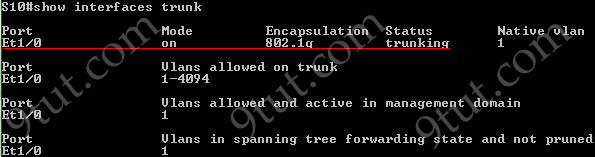
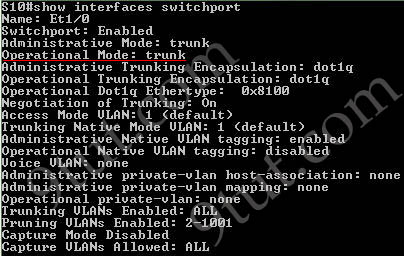
The “show interfaces trunk” command and “show interfaces switchport” command can be used to verify the status of an interface (trunking or not). The outputs of these commands are shown below (port Ethernet 1/0 has been configured as trunk):

Switch_show_interfaces_trunk.jpg

show_interfaces_switchport.jpg

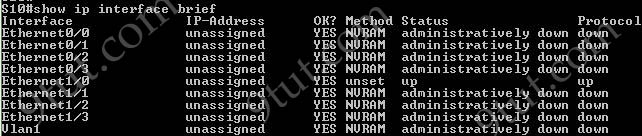
The “show ip interface brief” command only gives us information about the IP address, the status (up/down) of an interface:

show_ip_interface_brief.jpg

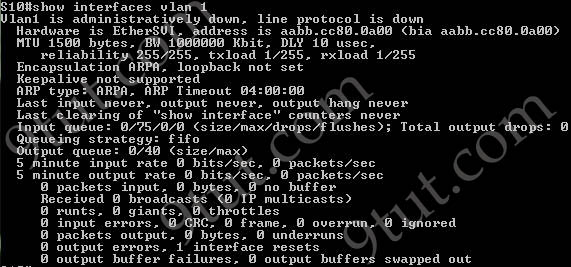
The “show interfaces vlan” command only gives us information about that VLAN, not about which ports are the trunk links:

show_interfaces_vlan.jpg

Trunking Questions

October 22nd, 2015

Question 1

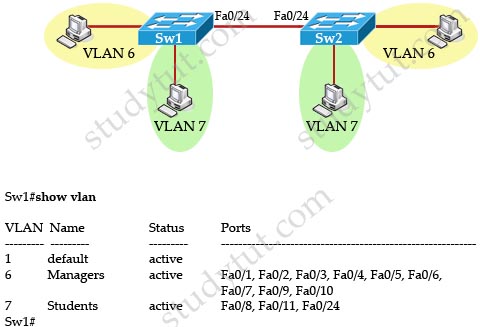
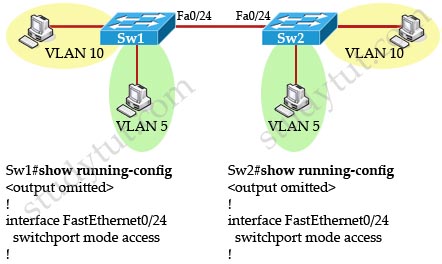
Your company network is having problem. Users in VLAN 6 on Sw1 cannot communicate with users in VLAN 6 on Sw2 but users in VLAN 7 on Sw1 can communicate normally with users on VLAN 7 on Sw2. The VLAN assignment configuration are identical on Sw1 and Sw2. What might cause this problem?

Two_switches_trunking.jpgA. The Fa0/24 interface is not working correctly on a switch
B. The Fa0/24 interface is not configured as trunk on Sw1
C. VLAN 1 does not have any ports in it and this cause problem
D. A router must be implemented so that users in VLAN 7 on two switches can communicate
E. The Fa0/24 must be configured in access mode


Answer: B

Explanation

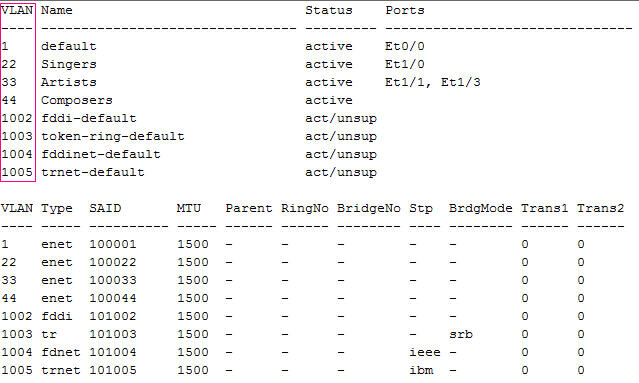
The show vlan command only displays access ports, the trunk ports are not shown in this command (we can use the “show interface trunk” command to see trunked ports). In the output we can see the ports Fa0/24 connecting between two switches in VLAN 7 -> they are access ports and only VLAN 7 can communicate. To make all VLANs can communicate (with the same VLAN at the other switch), the link between two switches must be set as trunk -> B is correct.

Question 2

What is the IEEE 802.1Q used for?

A. A protocol of EtherChannel
B. A method of VLAN tagging
C. A protocol of VLAN trunking
D. A method of describing MAC address
E. The Spanning-Tree Protocol


Answer: C

Question 3

What are the three modes of a VLAN trunk? (Choose three)

A. on
B. desirable
C. auto
D. alternative
E. forwarding
F. waiting


Answer: A B C

Question 4

Refer to the topology below

Two_switches_trunking_access.jpgNone of the users on Sw1 can communicate with users on the same VLAN on Sw2. Suppose all the switch ports are correctly assigned to suitable VLANs. What might be the problem in this case?
A. VLAN 1 must has at least one active user
B. The link between two switches must be configured in one of the above VLANs
C. VTP must be enabled on both switches
D. Each switch must have an IP address so that they can communicate
E. The link between two switches should be configured as trunk


Answer: E

Question 5

After DTP completes, which IEEE protocol will be used next on a switch?

A. 802.1Q
B. 802.3a
C. 802.1af
D. 803.6
E. 803.3w


Answer: A

Explanation

Dynamic Trunking Protocol (DTP) is a Cisco proprietary protocol for negotiating trunking on a link between two devices and for negotiating the type of trunking encapsulation (802.1Q) to be used.

Question 6

What statements are correct about IEEE 802.1Q trunking protocol?

A. By default the native VLAN frames are tagged with special ID
B. By default the native VLAN frames are not tagged
C. 802.1Q requires the trunk must be set at full-duplex
D. 802.1Q trunking can be use on both 10 Mbps and 100 Mpbs interfaces
E. 802.1Q requires the native VLAN must be matched on both ends


Answer: B D E

Question 9

What are the characteristics of 802.1Q protocol? (Choose two)

A. 802.1Q protocol modifies the 802.3 frame header, thus requires a recalculation of the original FCS field.
B. 802.1Q protocol supports tagged and untagged frames
C. 802.1Q is a Layer 2 protocol that helps synchronize VLAN database between switches in a network
D. 802.1Q is a Layer 2 protocol that prevents Layer 2 loops occur in the network
E. 802.1Q is a Layer 3 protocol that supports hosts in different VLANs can communicate


Answer: A B

Explanation

IEEE 802.1Q is the networking standard that supports Virtual LANs (VLANs) on an Ethernet network. It is a protocol that allows VLANs to communicate with one another using a router. 802.1Q trunks support tagged and untagged frames.

If a switch receives untagged frames on a trunk port, it believes that frame is a part of the native VLAN. Also, frames from a native VLAN are not tagged when exiting the switch via a trunk port.

The 802.1q frame format is same as 802.3. The only change is the addition of 4 bytes fields. That additional header includes a field with which to identify the VLAN number. Because inserting this header changes the frame, 802.1Q encapsulation forces a recalculation of the original FCS field in the Ethernet trailer.

Note: Frame Check Sequence (FCS) is a four-octet field used to verify that the frame was received without loss or error. FCS is based on the contents of the entire frame.

Question 10

What are the three trunking modes on switch ports? (Choose three)

A. auto
B. desirable
C. blocking
D. desirable
E. learning
F. listening
G. on


Answer: A B G

VLAN Questions

October 22nd, 2015

Question 1

What are the advantages of using VLANs in a network? (Choose three)

A. Mitigate the destruction of broadcast storms by decreasing the number of broadcast domains; this increases their size
B. Increase network security by separating important data into dedicated VLANs
C. Mitigate the destruction of broadcast storms by increasing the number of broadcast domains; this decreases their size
D. Efficient use of bandwidth by allowing logical networks to use the same infrastructure
E. Efficient use of bandwidth by allowing physical networks to use the same infrastructure


Answer: B C D

Question 2

Your switch does not have VLAN 10. What will happen if you enter the command “switchport access vlan 10” under interface configuration mode?

A. An error message will be shown
B. The interface will be put into err-disabled status
C. The command will be accepted and VLAN 10 will be created automatically in the VLAN database
D. The command will be accepted but VLAN 10 will not be created automatically

Answer: C

Question 3

What are the benefits of VLANs? (Choose three)

A. VLANs separate broadcast domains
B. VLANs helps save the IP addresses
C. VLANs reduces the latency between the devices in the network
D. VLANs allow access to the network based on logical location
E. VLANs allow access to the network based on physical location
F. VLANs helps creating, moving and changing hosts easily


Answer: A D F

Question 4 <Can draw picture>

Your colleagues have just asked you why his hosts in VLAN 2 can communicate with other hosts in the same VLAN but cannot communicate with hosts in another VLAN. All the hosts are connecting to a Layer 2 switch. What will you tell him?

A. Connect a router to the switch and configure an IP address on the physical interface connecting to the switch
B. Connect a router to the switch and configure subinterfaces on the physical interface connecting to the switch
C. Connect the switch to another Layer 2 switch and configure trunking between them
D. Connect the switch to another Layer 2 switch and configure accessing mode between them

Answer: B

Question 5

Two switches are connected together and a 802.1q trunk is configured between them. On Sw1, VLAN 50 is chosen as native VLAN while no native VLAN is specified on Sw2. What will be the result of this?

A. No problem with above configuration
B. Sw1 will add VLAN tag for VLAN 50 before sending to Sw2
C. VLAN 50 on Sw1 and VLAN 1 on Sw2 will send tagged frames
D. Giant frames are sent out of the link
E. A native VLAN mismatch error will appear


Answer: E

Question 6

What are the advantages of VLANs? (Choose three)

A. VLANs allow logical grouping of hosts by function, not by geography
B. VLANs helps increase network security
C. VLANs increase the size of each broadcast domain
D. VLANs decrease the size of each broadcast domain
E. VLANs increase the size of each collision domain
F. VLANs decrease the size of each collision domain
G. VLANs helps simplify the administration

Answer: A B D

Question 7 <Seems not correct – Going to removed>

A user on VLAN 5 of Sw1 sends frames to Sw2 but the frames were received on VLAN 10. What is the problem here?

A. Missing configuring trunk between two switches
B. The native VLANs on two switches are mismatched
C. VLAN 10 is not allowed on trunk
D. VLAN 5 is not allowed on trunk

Answer: B

Question 8

Which of the following statements describe VLAN operation on the switches is correct?

A. Unknown unicast frames are only re-sent to all ports in the same VLAN
B. The link between two switches should be configured in access mode
C. Unknown unicast frames are re-sent to all ports in a different VLAN
D. The VLAN ID of a 802.1q frame can be derived from the source MAC address table

Answer: A

Explanation

Answer D is not correct because when a packet is received from an 802.1Q trunk, it always carries VLAN ID information in the VLAN tag portion so the switch does not need to look up its source MAC address table to determine the VLAN ID of that packet.

Question 9

What are the benefits of creating VLANs? (Choose two)

A. increase the security in the network
B. increase the bandwidth in the network
C. provides segmentation in the network
D. increase collision domains in the network
E. bandwidth is dedicated for some applications

Answer: A C

Question 10

Which range of VLAN can be added or modified or removed on the switch by default?

A. 1 to 1001
B. 2 to 1002
C. 2 to 1001
D. 2 to 1005

Answer: C

Explanation

VLAN 1 is the default VLAN on Cisco switch. It always exists and can not be added, modified or removed.

VLANs 1002-1005 are default VLANs for FDDI & Token Ring and they can’t be deleted or used for Ethernet.

regular_vlan.jpg

Switch Questions 2

October 21st, 2015

Question 1

What address does a switch use to determine where to forward the received frames?

A. source Layer 2 address
B. destination Layer 2 address
C. source Layer 3 address
D. destination Layer 3 address

Answer: B

Question 2

<Giong voi cau 10 phan Switch o tren>

Question 3

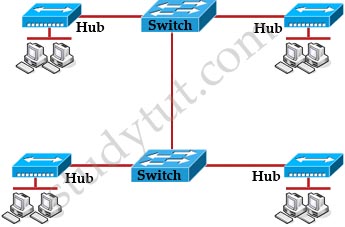
Refer to the below topology.

switch_hub_collision_broadcast_domains.jpg

How many broadcast domains in the topology below?

A. one
B. two
C. six
D. thirteen

Answer: A

Question 4

The partial output below shown after the switch is powered on. Which of the following statements are correct about the status of this switch? (Choose two)

….
01:01:15: %LINK-5-CHANGED: Interface Vlan 1, changed state to administratively down
01:01:15: %LINK-3-UPDOWN: Interface GigabitEthernet0/1, changed state to up
01:01:15: %LINEPROTO-5-UPDOWN: Line protocol on Interface GigabitEthernet0/1, changed state to up
….

A. Currently interface Gi0/1 is up
B. Currently interface Gi0/1 is administratively down
C. Interface Vlan 1 will need some time to change the state to up  
D. Remote management to this switch is not available without further configuration

Answer: A D