Author Archive

Subnetting Questions

November 29th, 2015

Question

Which of the following subnets allow to create a maximum of 30 usable host addresses on a subnet? (Choose two)

A. /26
B. /27
C. /28
D. 255.255.255.192
E. 255.255.255.224
F. 255.255.255.240


Answer: B E

Question

A default gateway is assigned the IP address of 168.9.10.67/28. Which IP addresses can be assigned to a host that use the above default gateway? (Choose two)

A. 168.9.10.63
B. 168.9.10.64
C. 168.9.10.65
D. 168.9.10.79
E. 168.9.10.78


Answer: C E

Question

What is the binary number of decimal 240?

A. 11110000
B. 11100000
C. 11000000
D. 11111000
E. 11111100


Answer: A

Question

What is the broadcast address of the 6th subnet created by the 192.168.1.0/28?

A. 192.168.1.80
B. 192.168.1.65
C. 192.168.1.96
D. 192.168.1.95


Answer: D

Explanation

Increment: 16
1st: 192.168.1.0
2nd: 192.168.1.16
3rd: 192.168.1.32
4th: 192.168.1.48
5th: 192.168.1.64
6th: 192.168.1.80
7th: 192.168.1.96

Question

What is the best subnet mask used for point-to-point connection?

A. /29
B. /30
C. /31
D. /32
E. /0


Answer: B

VTP Questions

November 29th, 2015

Question 1

Which of the following protocol does an interface need to run before enabling VTP?

A. DTP
B. STP
C. 802.1Q
D. CDP


Answer: C

Explanation

VTP packets are sent on trunk links so a trunking protocol must be enabled on an interface. The most popular trunking protocol is 802.1Q.

Question 2

Your switch is running VTP. Which VTP mode does not let you create new VLANs?

A. Server mode
B. Client mode
C. Transparent mode
D. Off mode
E. Primary mode


Answer: B

Explanation

Unlike “Server mode” or “Transparent mode”, you cannot create new VLAN on a switch running “Client mode”. There is no “Off mode” or “Primary mode” (but there is a “Primary Server mode” in VTPv3).

STP Questions

November 27th, 2015

Question 1

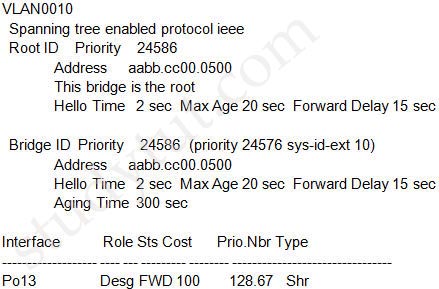
From the output below, what is the role of Switch1 for VLAN 10?

Switch1#show spanning-tree vlan 10

STP_Root_Bridge.jpg

A. alternative switch
B. root bridge
C. main switch
D. main bridge
E. redundant switch


Answer: B

Explanation

From the “This bridge is the root” line we can conclude this switch is the root bridge for VLAN 10.
Note: Here the term “bridge” and “switch” are used interchangeable.

Question 2

What values does Spanning Tree Protocol use to elect a root bridge? (Choose two)

A. MAC address
B. IP address
C. Bridge Priority
D. IOS version
E. CPU speed


Answer: A C

Explanation

Spanning Tree Protocol (STP) uses the Bridge ID to elect a root bridge. The lower value of the Bridge ID, the higher priority it has to become a root bridge. The Bridge ID is composed of the bridge priority value (0-65535, 2 bytes) and the bridge MAC address (6 bytes).

Bridge ID = Bridge Priority + MAC Address

For more information about how STP elects a root bridge, please read our STP tutorial.

Question 3

Which STP states were replaced with the Rapid STP (RSTP)? (Choose three)

A. learning
B. listening
C. blocking
D. forwarding
E. disabled


Answer: B C E

Explanation

The table below compares the traditional STP and RSTP states:

STP State (802.1d) RSTP State (802.1w)
Blocking Discarding
Listening Discarding
Learning Learning
Forwarding Forwarding
Disabled Discarding

From this table we can see that Blocking, Listening and Disabled states in STP are replaced with Discarding state in RSTP.

InterVLAN Routing Questions

November 27th, 2015

Question 1

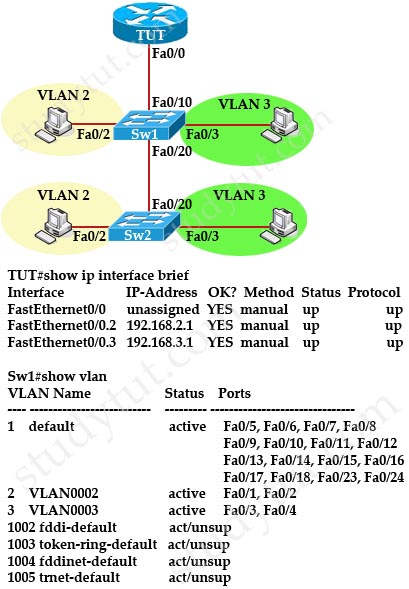
Checking the topology and configuration below.

Switch_trunking.jpg

Suppose all the computers are configured correctly with IP addresses and default gateways. But none of them can ping to the TUT router. Which commands would fix this problem?

A.
TUT(config-if)#interface fa0/0
TUT(config-if)#encapsulation dot1q
B.
TUT(config)#interface encapsulation dot1q
C.
Sw1(config)#interface fa0/10
Sw1(config)#switchport mode trunk
D.
Sw1(config)#interface fa0/10
Sw1(config)#switchport access vlan 2,3


Answer: C

Explanation

From the output of the “show vlan” command on Sw1, we learn that the Fa0/10 interface (which connects to TUT router) is in VLAN 1 (and it operates in access mode). This is not correct because TUT router is operating as the router-on-a-stick. Therefore the Fa0/10 interface on Sw1 must be configured as trunk.

OSPF Questions

November 24th, 2015

Question 1

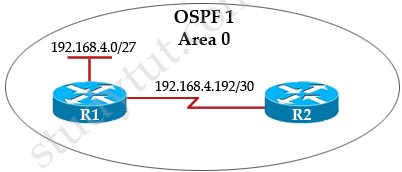
Which OSPF commands should be configured on R1 to enable OSPF?

OSPF_Configure.jpg

A.
router ospf 1
 network 192.168.0.0 area 0

B.
router ospf 1
 network 192.168.4.0 0.0.0.31 area 0

C. router ospf 1
 network 192.168.4.0 0.0.0.31 area 0
 network 192.168.4.192 0.0.0.3 area 0

D. router ospf 1
 network 192.168.4.0 0.0.0.31 area 0
 network 192.168.4.192 0.0.0.0 area 0


Answer: C

Explanation

The subnets in “network …” statements under OSPF process should cover all the interfaces’ IP addresses so that OSPF can run on all interfaces of the router. In this case the “network 192.168.4.0 0.0.0.31 area 0” statement covers the IP address 192.168.4.0/27 and the “network 192.168.4.192 0.0.0.3 area 0” statement covers the IP address 192.168.4.192/30.

Question

What is the default Layer 2 encapsulation protocol used on a synchronous serial interface of a Cisco router?

A. Frame Relay
B. PPP
C. HDLC
D. CHAP
E. PAP


Answer: C

Explanation

The default serial encapsulation on Cisco routers is Cisco HDLC, so it does not need to be explicitly configured on the router. As a result, the encapsulation type is not displayed in the configuration.

Note: Cisco HDLC (also known as cHDLC) is an extension to the High-Level Data Link Control network protocol created by Cisco

Question

Which of the following commands can be used to check the network statements which were used with OSPF?

A. show ip ospf interface
B. show ip route
C. show ip ospf neighbor
D. show ip protocols


Answer: D

Explanation

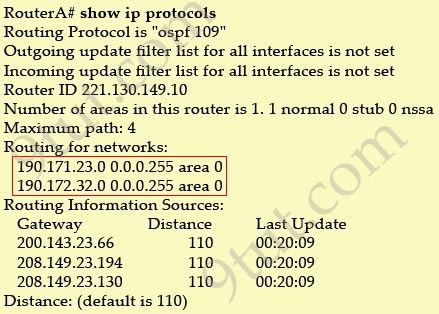
The “show ip protocols” can be used to check the network statements used under OSPF process. For example, if we use these commands:

router ospf 109
 network 190.171.23.0 0.0.0.255 area 0
 network 190.172.32.0 0.0.0.255 area 0

Then we can see these networks under “Routing for networks” field of the “show ip protocols” command:

show_ip_protocols_OSPF.jpg

Basic Questions

November 24th, 2015

Question 1

Which of the following devices can segment collision domains? (Choose two)

A. Hubs
B. Repeaters
C. Bridge
D. Switch
E. Transceiver


Answer: C D

Explanation

A Layer 2 device can separate collision domains while a Layer 3 device can separate broadcast domains (and collision domains too). Bridge and switch operate in Layer 2 so they can segment collision domains.

Question 2

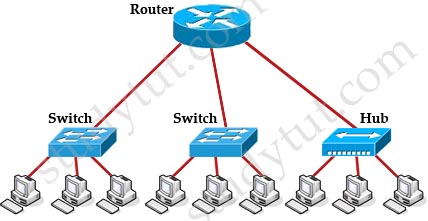
How many collision domains and broadcast domain in this topology? (Choose two)

Collision_and_Broadcast_Domains.jpg

A. One broadcast domain
B. Two broadcast domains
C. Three broadcast domains
D. Nine collision domains
E. Ten collision domains
F. Twelve collision domains


Answer: C E

Explanation

Remember these facts for Ethernet medium:
+ Each port on a switch creates a collision domain
+ Each port on a router creates a collision domain and broadcast domain
+ Layer 1 devices (like hub, repeater) do not create collision or broadcast domain

Therefore we can see there are 9 collision domains (four collision domains on each switch and one for the hub) and three broadcast domains for each interface of the router.

OSI & TCP/IP Model

November 24th, 2015

Question

Which OSI layer does UDP operate in?

A. Layer 1
B. Layer 2
C. Layer 3
D. Layer 4
E. Layer 5


Answer: D

Explanation

User Datagram Protocol (UDP) and Transmission Control Protocol (TCP) operate in Transport Layer (Layer 4). UDP provides a connectionless (a communication session between hosts is not established before exchanging data), unreliable transport service. UDP is often used in real-time services such as voice or video.

Question

Which layer in the TCP/IP model is responsible for sending packets to the destination?

A. Application Layer
B. Session Layer
C. Internet Layer
D. Network Layer
E. Transport Layer


Answer: C

Explanation

The Internet Layer of the TCP/IP model is similar to the Network Layer (Layer 3) of the OSI Model so it is responsible for sending packets to the destination.

Question

Which term is used to describe data in Layer 4 of the OSI model?

A. Packet
B. Frame
C. Bit
D. Segment
E. LSU


Answer: D

Explanation

Layer 4 of the OSI Model is the Transport Layer and the unit of the data in this layer is called “Segment”. In Layer 3 (Network Layer) it is called “Packet”, in Layer 2 (Data Link Layer) it is called “Frame” and in Layer 1 (Physical Layer) it is called “Bit”.

Question

PC1 discarded a frame because it was corrupted. Which OSI layer is responsible for this elimination?

A. Layer 4
B. Layer 3
C. Layer 2
D. Layer 1
E. Layer 5


Answer: C

Explanation

When the unit of a data is called “Frame”, we will know it is proceeding in the Data Link Layer (Layer 2).

Question

What are the OSI layer names from Layer 3 to Layer 5? (Choose three)

A. Application
B. Transport
C. Network
D. Presentation
E. Session


Answer: B C E

Question

What are the layer names of the TCP/IP model?

A. Network, Application, Data Link, Physical
B. Application, Transport, Internet, Data Link
C. Internet, Application, Network Interface, Transport
D. Application, Network, Internet, Transport
E. Data Link, Network, Physical, Transport


Answer: C

Explanation

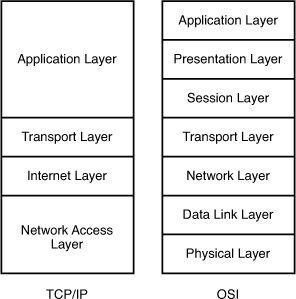
The name of the TCP/IP model and OSI model is shown below:

OSI_TCP_IP_Comparison.jpg

Question

Which of the following protocols use TCP? (Choose three)

A. FTP
B. SNMP
C. TFTP
D. SMTP
E. DNS


Answer: A D E

Explanation

Note: DNS uses both TCP and UDP

Question

Which of the following protocols operate over UDP? (Choose two)

A. HTTP
B. SNMP
C. SQL
D. Telnet
E. TFTP


Answer: B E

Question

Which transport protocol requires a three-way handshake before establishing a connection?

A. UDP
B. TCP
C. IP
D. ARP
E. Gracious ARP


Answer: B

VLAN Questions

November 24th, 2015

Question 1

Which network device should you use to divide a network into VLANs?

A. router
B. switch
C. bridge
D. hub
E. transceiver


Answer: B

Explanation

Switch is the most popular networking device used to divide a network into multiple Virtual Local Area Networks (VLANs). Each VLAN can be considered a separate broadcast domain.

Question 2

Which of the following statements are correct about VLANs? (Choose two)

A. It defines a collision domain
B. It defines a broadcast domain
C. A Layer 2 device is required to route between VLANs
D. A Layer 3 device is required to route between VLANs


Answer: B D

Explanation

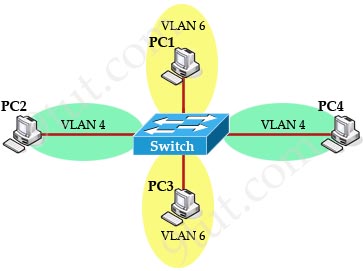
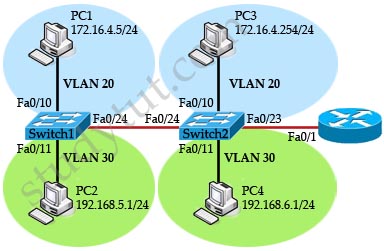
A VLAN can be considered a separate broadcast domain as a host in a VLAN can only send packets to other hosts in the same VLAN through a Layer 2 switch. Broadcasts can also be sent in the same VLAN of the originating host. For example in the picture below, PC2 can only communicate to PC4, PC1 can only communicate to PC3:

VLANs_switch.jpg

Note: To communicate with hosts in another VLAN, a Layer 3 device (like a router) must be used.

Question 3

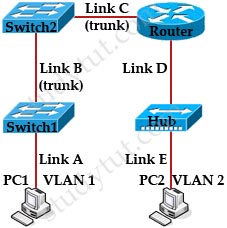
PC1 is communicating with PC2. On which links will a VLAN ID tag be included in the frame?

VLAN_Tag.jpg

A. LinkA, LinkB, LinkC, LinkD, LinkE
B. LinkA, LinkE
C. LinkB, LinkD
D. LinkA, LinkD
E. LinkB, LinkE
F. LinkB, LinkC


Answer: F

Explanation

The important thing to remember is switch only tags a VLAN ID when it is going to send to a trunk link. And a trunk link is usually the link connecting two switches. A switch will remove the VLAN ID tag before sending to an access link. In this case the trunk links are the links between Switch 1, Switch 2 and the Router (Link B and C). The link between Switch2 and the Router is configured as a trunk link (at Switch2 side) for InterVLAN routing.

Question 4

Checking the topology below. Why does PC2 cannot communicate with PC4 in the same VLAN?

same_VLAN_problem.jpg

A. Subinterfaces should be configured on the router
B. Interface Fa0/23 of Switch2 should configured as a trunk link
C. The IP address assignment on PC4 is not correct
D. The link between two switches must be configured as a trunk link


Answer: C

Explanation

Although PC2 and PC4 is in the same VLAN but they are not in the same subnet so they cannot communicate with each other.

All uncategorized free questions post here

November 23rd, 2015

Question

Which of the following options is a distance vector protocol?

A. OSPF
B. EIGRP
C. VTP
D. STP


Answer: B


IP Address Questions

November 17th, 2015

Question 1

Which class of IP address space does the IP address 12.1.1.3 belong to ?

A. Class A
B. Class B
C. Class C
D. Class D


Answer: A

Explanation

The table below summarizes the ranges of IP address class A, B and C with their default subnet masks.

  Default subnet mask Range
Class A 255.0.0.0 (/8) 1.0.0.0 – 126.255.255.255
Class B 255.255.0.0 (/16) 128.0.0.0 – 191.255.255.255
Class C 255.255.255.0 (/24) 192.0.0.0 – 223.255.255.255

From this table we can see IP address 12.1.1.3 belongs to class A.

Question 2

You are tasked to choose an IP address to go to the Internet on your router. Which of the following IP address can do this task?

A. 10.6.4.5
B. 8.5.6.2
C. 172.16.123.1
D. 192.168.1.223


Answer: B

Explanation

The IP address which can be assigned to an Internet interface is a public IP address. Private IP address are found in the following ranges:

* From 10.0.0.0 to 10.255.255.255
* From 172.16.0.0 to 172.31.255.255
* From 192.168.0.0 to 192.168.255.255

Also some special IP addresses (like the local loopback address 127.0.0.1, multicast addresses…) can’t be assigned to an Internet interface.

In this question only answer B doesn’t belong to the range of private IP address -> B is the correct answer.

Question 3

Your colleague has just assigned the IP address 10.10.10.1 to an interface on a router which is directly connected to the Internet. What will be the result of this action?

A. It is a private IP address so it cannot be not routed on the Internet.
B. The router can access the Internet
C. The router will automatically convert this IP address to a public IP address by NAT
D. The router will inform an IP address conflict and the router cannot access the Internet


Answer: A

Explanation

The IP address 10.10.10.1 is a private IP address and it can’t access the Internet. You usually need to manually configure Network Address Translation (NAT) to convert it into a public IP address before sending packets to the Internet.

Question 4

Your server has just been setup with TCP/IP stack. You want to ping the loopback IP address of this server. Which IP address should you ping?

A. 10.10.10.10
B. 1.1.1.1
C. 192.168.1.1
D. 127.0.0.1
E. 0.0.0.0


Answer: D

Explanation

The IP address of 127.0.0.1 is the well-known loopback IP address on a computer. When try pinging this address, you are testing if the TCP/IP stack is working or not.

Question 5

Check the topology below.
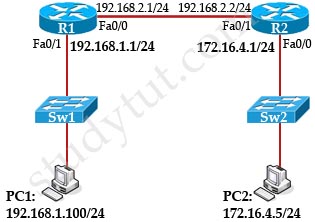
Default_Gateway.jpg

Which value will be configured for Default Gateway of PC1 so that PC1 can communicate with PC2?

A. 192.168.1.1
B. 192.168.1.2
C. 172.16.4.1
D. 172.16.4.2


Answer: A

Explanation

PC1 (192.168.1.100) and PC2 (172.16.4.5) are in different networks so they need to have a default gateway to communicate with each other. In this topology only router R1 can help PC1 to reach PC2 as router is a Layer 3 device and is responsible for sending/receiving packets from different networks.

Question 6

Checking the IP address assignment in the topology below.
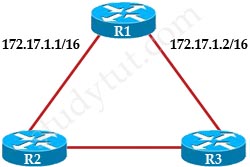
Router_IP_Assignment.jpg

What conclusions can be made about this IP address assignment?

A. There is no problem with this assignment
B. The router will not accept this IP address assignment.
D. The connection between routers should be configured as trunks.
E. The router interfaces must be encapsulated with the 802.1Q protocol.


Answer: B

Explanation

Each interface on a router must be in a different network. If two interfaces are in the same network, the router will not accept it and show error when the administrator assigns it. In this case two interfaces on R1 are assigned IP addresses 172.17.1.1/16 and 172.17.1.2/16 which are in the same network -> R1 will not accept this IP address assignment.

Question 7

Which two statements describe the IP address 190.15.34.46/24? (Choose two)

A. The subnet mask of this IP address is 255.255.255.0.
B. The subnet mask of this IP address is 255.255.0.0.
C. This is a class B IP address
D. This is a class C IP address


Answer: A C

Explanation

The table below summarizes the ranges of IP address class A, B and C with their default subnet masks.

  Default subnet mask Range
Class A 255.0.0.0 (/8) 1.0.0.0 – 126.255.255.255
Class B 255.255.0.0 (/16) 128.0.0.0 – 191.255.255.255
Class C 255.255.255.0 (/24) 192.0.0.0 – 223.255.255.255

From this table we can see IP address 190.15.34.46 belongs to class B. But please notice that it is not using class B default subnet mask (/16). It is using /24, which is 255.255.255.0 subnet mask. “/24” here means 24 bits 1 written successively at the left of a subnet mask in binary form (which is 1111 1111.1111 1111 1111.1111 1111.0000 0000). After converting it into decimal form we get 255.255.255.0.

Question 8

What are the network address and broadcast address of the network 192.9.10.2/24?

A. 192.9.10.255
B. 192.9.255.255
C. 192.9.10.0
D. 192.9.0.0
E. 192.0.0.0
F. 192.255.255.255


Answer: A C

Explanation

From the subnet mask /24 (255.255.255.0) we learn that the major network of this IP address is 192.9.10.0/24 (keep the first 24 bits of this IP address and replace the rest with bit 0). Therefore the network address of this network is 192.9.10.0 and the broadcast address is 192.9.10.255.